Every product, every service, and every brand that you love and see is marketed by a digitally skilled marketer.
Nowadays, being skilled in the field of digital marketing can bring a lot of opportunities to earn more money.
Becoming a digital marketing freelancer brings a load of opportunities to earn more experience as well as increase your number of income sources. But the question arises how to become a digital marketing freelancer? Well don’t worry
Clients are assisted by freelance digital marketers in creating, executing, and measuring campaigns that promote their products or services.
Starting a career as a digital marketing freelancer involves several steps, including building an audience and establishing connections with brands.
In this blog post, we are going to understand what is a freelancer in digital marketing, what are the skills required to become a digital marketing freelancer, and how can you gain these freelancing opportunities.
Who is a Digital Marketer Freelancer?
A freelancer in digital marketing is a professional who operates independently, offering a range of marketing services to businesses or clients on a contract basis.
A freelancer in digital marketing is adept at leveraging digital channels and tools to promote brands, products, or services in the online realm. These individuals possess a diverse skill set encompassing various aspects of digital marketing, such as
Strategic Planning: Freelancers strategize and develop comprehensive digital marketing plans tailored to meet specific business objectives. They analyze market trends, conduct competitor research, and identify target audiences to create effective campaigns.
Content Creation and Marketing: Being a freelancer in digital marketing needs to excel in crafting engaging content for various platforms, including websites, social media, emails, and blogs. This involves not only creating content but also optimizing it for search engines (SEO) and ensuring it resonates with the intended audience.
Social Media Management: Freelancers proficient in digital marketing handle social media accounts, curating content, engaging with the audience, and running targeted ad campaigns across platforms like Facebook, Instagram, Twitter, LinkedIn, and more.
SEO and SEM Expertise: They understand search engine optimization (SEO) techniques to enhance website visibility in search engine results, as well as pay-per-click (PPC) advertising strategies to increase online visibility and drive traffic.
Analytics and Performance Tracking: Utilizing tools like Google Analytics, freelancers in digital marketing measure campaign performance, analyze data, and derive insights to optimize marketing strategies. They monitor key performance indicators (KPIs) to demonstrate the effectiveness of their efforts.
Freelancers in digital marketing possess adaptability, staying updated with evolving technologies, industry trends, and algorithm changes across various digital platforms.
They often work remotely, managing multiple projects simultaneously and offering their expertise to clients seeking specialized marketing services without committing to a full-time employee.
These professionals have the freedom to choose their clients, projects, and work schedules, allowing for a flexible lifestyle.
The role requires a combination of creativity, analytical thinking, communication skills, and a solid understanding of digital marketing tools and methodologies to deliver successful campaigns that drive business growth for their clients.
Scope of a Digital Marketing Freelancer
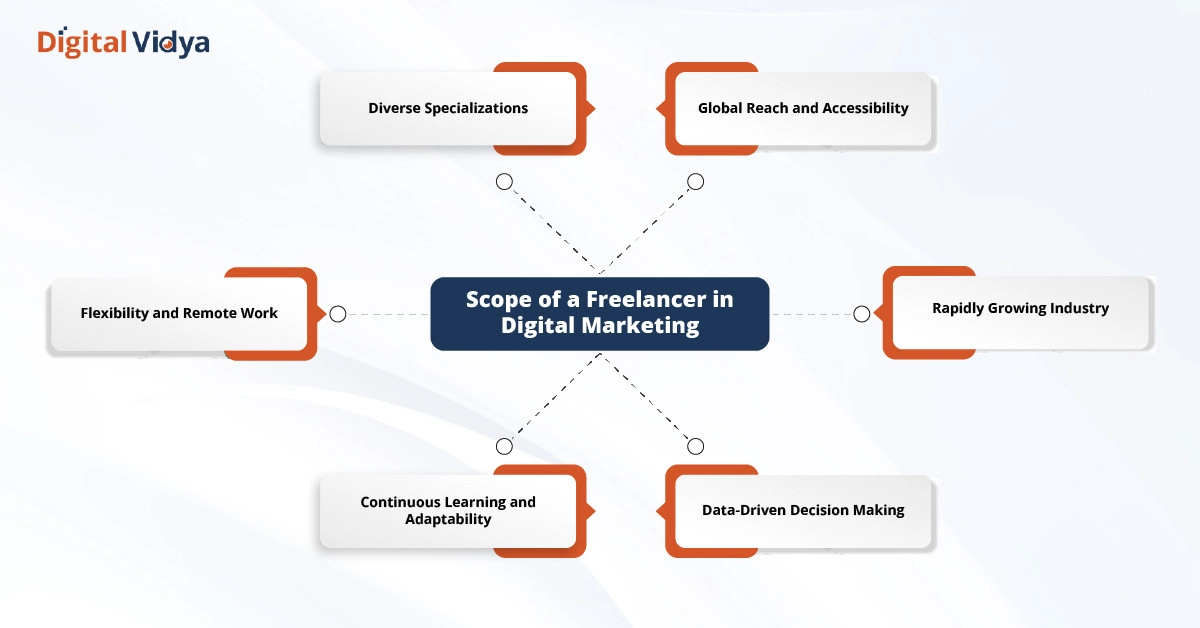
The scope of a freelancer in digital marketing is vast, continuously evolving, and offers immense opportunities for those entering or already established in the field. Here are key aspects highlighting its scope:
Diverse Specializations:
- Digital marketing encompasses various specialized areas, allowing freelancers to focus on specific niches. For instance, a freelancer might specialize in content marketing, social media management, SEO/SEM, email marketing, or digital advertising.
- Example: A freelancer might excel in crafting compelling content strategies for businesses, tailoring content to resonate with different audiences across platforms.
Global Reach and Accessibility:
- Freelancers in digital marketing have a global market at their fingertips. They can work with clients from anywhere in the world, transcending geographical boundaries.
- Example: A freelancer based in India might collaborate with a startup in the United States to manage their social media presence and run targeted ad campaigns.
Flexibility and Remote Work:
- One of the most appealing aspects of being a digital marketing freelancer is the flexibility it offers. They can work remotely, setting their own schedules and choosing clients/projects that align with their expertise and interests.
- Example: A freelancer in digital marketing might work on social media management for a tech startup during the day and handle content creation for an e-commerce brand in the evening, all from the comfort of their home office.
Rapidly Growing Industry:
- The digital marketing industry is expanding rapidly, driven by the increasing reliance on online platforms by businesses to reach their audiences. This growth translates to a higher demand for skilled freelancers.
- Example: According to Statista, Ad spending in the Advertising market worldwide is forecasted to reach US$1.17tn in 2025, indicating the escalating need for digital marketing expertise.
Data-Driven Decision Making:
- Freelancers leverage data analytics tools to measure campaign performance, derive insights, and make informed decisions. Understanding data is crucial for optimizing strategies and demonstrating ROI to clients.
- Example: A freelancer might analyze metrics from Google Analytics or social media insights to tweak ad targeting or refine content strategies for better engagement.
Continuous Learning and Adaptability:
- The digital landscape is ever-evolving, requiring freelancers to stay updated with the latest trends, algorithms, and technologies. Continuous learning is key to remaining competitive.
- Example: Freelancers might attend industry conferences, enroll in online courses, or join communities to stay abreast of the latest digital marketing practices.
The scope for freelancers in digital marketing is broad and dynamic, offering avenues for growth, creativity, and the potential to make a substantial impact on businesses across industries.
The 8 Essential Skills Every Successful Freelancer Needs
To become a successful freelance digital marketer, several key skills and qualifications are essential:
Digital Marketing Expertise:
- Proficiency in various aspects of digital marketing, including SEO, content marketing, social media management, email marketing, PPC advertising, and analytics.
- Example: A freelancer adept in SEO techniques can help businesses improve their website’s search engine rankings, increasing organic traffic and visibility.
Content Creation and Copywriting:
- Strong writing skills to create compelling and engaging content across different platforms and formats.
- Example: A freelancer capable of crafting persuasive ad copy or engaging blog posts can drive audience engagement and conversions for their clients.
Analytical Skills:
- Ability to interpret data, analyze metrics, and derive actionable insights from tools like Google Analytics, social media analytics, and marketing automation platforms.
- Example: A freelancer proficient in analytics can measure campaign performance, identify trends, and optimize strategies for better ROI.
Tech Savviness:
- Familiarity with various digital marketing tools and platforms such as Google Ads, Facebook Business Manager, email marketing software (e.g., Mailchimp), and CRM systems.
- Example: Knowledge of Facebook Ads Manager enables a freelancer to create targeted ad campaigns for businesses, reaching specific demographics.
Strategic Thinking and Planning:
- Ability to develop comprehensive digital marketing strategies aligned with client goals, considering market trends and consumer behavior.
- Example: Crafting a social media calendar with planned content and campaigns aligned with seasonal trends or events to maximize impact.
Creativity and Adaptability:
- Innovative thinking to create unique campaigns, adapt to evolving trends, and experiment with new strategies.
- Example: A digital marketing freelancer might design engaging visual content or viral marketing campaigns that resonate with the target audience.
Communication and Client Management:
- Strong interpersonal skills to communicate effectively with clients, understand their needs, and manage projects efficiently.
- Example: Regular updates and clear communication with clients throughout campaigns ensure alignment and satisfaction with the delivered services.
Continuous Learning and Certifications:
- Commitment to staying updated with industry trends, obtaining certifications (e.g., Google Analytics, HubSpot), and pursuing ongoing learning opportunities.
- Example: According to LinkedIn, professionals who showcase their certifications on their profiles receive 33% more views.
Acquiring these skills can be through formal education, online courses, certifications, hands-on experience, or a combination thereof.
Successful freelance digital marketers continually hone their skills to deliver effective and innovative strategies that drive results for their clients.
Your 7-Step Roadmap to a Freelance Digital Marketing Career

Becoming a digital marketing freelancer involves several practical steps to establish yourself in the industry:
Step 1: Choose Your Profitable Niche (and Specialize)
- Identify your expertise and the specific digital marketing services you’ll offer. Focus on areas where you excel, such as SEO, social media management, content creation, or email marketing.
- Example: A freelancer might specialize in content marketing for e-commerce businesses, creating compelling product descriptions and blog posts.
Step 2: Build Your Brand and Portfolio:
- Develop a strong personal brand that reflects your skills and values. Create a professional website showcasing your portfolio, case studies, client testimonials, and previous work.
- Example: A freelancer might create a portfolio highlighting successful ad campaigns, SEO improvements, or social media engagement growth for past clients.
Step 3: Set Up Your Business Legally and Financially:
- Register your freelance business, obtain the necessary licenses, and set up a separate business bank account. Determine your pricing structure, payment methods, and invoicing processes.
- Example: Freelancers might choose between hourly rates, project-based fees, or retainer agreements depending on the services offered and the client’s needs.
Step 4: Market Yourself Effectively:
- Utilize various marketing channels to promote your services. This includes leveraging social media, networking on professional platforms like LinkedIn, and creating valuable content to showcase expertise.
- Example: A freelancer might publish informative blog posts about digital marketing strategies on their website and share them across social media to attract potential clients.
Step 5: Network and Establish Connections:
- Build relationships within the industry by attending events, joining relevant forums or groups, and connecting with potential clients or other professionals.
- Example: Engaging in online communities or industry-specific groups can lead to referrals or collaborations with other freelancers.
Step 6: Finding Your First Clients: 5 Actionable Strategies
- Building a client base is the most challenging step for new freelancers. Here are five proven strategies to land your first clients.
- 1. Optimize Profiles on Freelance Platforms: This is the fastest way to find clients. Create detailed profiles on platforms like Upwork, Fiverr, and Toptal. Optimize your profile with keywords for your niche (e.g., “Real Estate SEO Specialist”). Write custom, personalized proposals for each job you apply to—avoid copy-pasting.
- 2. Leverage Your Existing Network: Inform your professional network on LinkedIn that you are now offering freelance services. Contact former colleagues, managers, and even friends and family. Your first client is often someone who already trusts you.
- 3. Network with Other Freelancers: Join online communities (like Facebook Groups or Slack channels) for digital marketers. Connect with other freelancers, especially those in complementary niches. A web designer may need an SEO specialist, or a content writer may need a PPC expert. These referral partnerships are invaluable.
- 4. Use “Warm” Cold Pitching: Identify 5-10 businesses in your niche that you genuinely believe you can help. Don’t send a generic email. Send a personalized video audit (using a tool like Loom) showing them 1-2 specific things they could improve (e.g., “I noticed your site is missing these 3 local keywords”). Offer a clear solution.
- 5. Build Your Portfolio with a Project: If you have no experience, create your own. Start a blog about your niche, run a small PPC campaign for a local nonprofit, or build a social media presence for a friend’s small business. Document the process and the results (e.g., “Grew Instagram followers by 150% in 30 days”) and use this as your first case study.
Step 7: Provide Exceptional Service and Deliver Results:
- Once you secure clients, ensure you deliver high-quality work and meet deadlines. Building a reputation for reliability and exceptional service will lead to client satisfaction and potential referrals.
- Example: Consistently meeting or exceeding key performance indicators (KPIs) agreed upon with clients, such as increased website traffic, higher engagement rates, or improved conversion rates.
Starting as a freelancer requires a strategic approach, persistence, and dedication to building a strong foundation for your business.
Over time, consistently delivering value to clients will help you establish a successful freelance career in digital marketing.
Building Your Brand & Finding Your First Clients
Effectively marketing yourself as a freelancer in the digital marketing realm is crucial for attracting clients and building a sustainable business. Here are key strategies:
Create a Strong Online Presence:
- Develop a professional website that showcases your skills, services offered, testimonials, and portfolio. Optimize it for SEO to increase visibility.
- Example: A digital marketing freelancer might use their website to display case studies detailing successful campaigns or client testimonials, highlighting expertise.
Utilize Social Media and Networking:
- Leverage social media platforms like LinkedIn, Twitter, and Instagram to showcase your expertise, share valuable content, and engage with potential clients or industry peers.
- Example: Regularly posting industry insights, and success stories, or offering free tips can position a freelancer as an authority in their niche.
Content Marketing and Thought Leadership:
- Create and share valuable content that demonstrates your knowledge and skills. This could include blogs, videos, infographics, or podcasts related to digital marketing.
- Example: Writing in-depth articles on marketing trends or producing how-to videos on effective social media strategies can attract an audience and potential clients.
Networking and Building Relationships:
- Engage in industry-specific forums, attend webinars, workshops, or conferences to connect with potential clients or collaborators. Nurture these relationships for future opportunities.
- Example: Actively participating in online communities or attending local marketing events can lead to referrals or partnerships with agencies seeking specialized skills.
Offer Free Resources or Consultations:
- Provide valuable resources like e-books, templates, or free consultations to showcase your expertise and build trust with potential clients.
- Example: A freelancer might offer a free SEO audit or a social media strategy session to demonstrate their knowledge and build rapport with prospects.
Collect and Showcase Testimonials and Case Studies:
- Request feedback and testimonials from satisfied clients. Showcase these testimonials and detailed case studies of successful projects on your website or social media.
- Example: Sharing statistics or quantifiable results from past campaigns can illustrate the impact of your work on a client’s business.
Optimize Your Online Profiles:
- Ensure your profiles on professional platforms like LinkedIn or freelance marketplaces are up-to-date and optimized with relevant keywords and a clear description of your services.
- Example: A well-optimized LinkedIn profile with a compelling headline and detailed summary can attract attention from potential clients searching for specific skills.
By implementing these strategies consistently, freelancers can effectively market themselves, establish credibility, and attract clients within the competitive landscape of digital marketing.
Tools and Resources for Digital Marketing Freelancer
Here’s a rundown of essential tools and resources for freelancers in digital marketing:
Analytics and Data Tools:
- Google Analytics: Provides insights into website traffic, user behavior, and campaign performance.
- Google Data Studio: Helps visualize and share data to create informative reports for clients.
- Social media analytics tools: Platforms like Facebook Insights, Twitter Analytics, and LinkedIn Analytics offer detailed data on post-performance, audience demographics, and engagement metrics.
SEO Tools:
- SEMrush or Ahrefs: Assists in keyword research, competitor analysis, and monitoring website rankings.
- Google Search Console: Helps track website performance in Google’s search results and identifies optimization opportunities.
Content Creation and Design Tools:
- Canva: Enables the creation of visually appealing graphics, social media posts, and marketing materials.
- Adobe Creative Cloud (Photoshop, Illustrator, etc.): Advanced tools for graphic design and content creation.
Email Marketing Platforms:
- MailChimp, Constant Contact, or HubSpot: Facilitates email campaign creation, automation, and performance tracking.
Social Media Management Tools:
- Hootsuite or Buffer: Allows scheduling posts across multiple social media platforms and analyzing their performance.
- Sprout Social: Offers comprehensive social media management and analytics features.
Project Management and Collaboration Tools:
- Asana, Trello, or Monday.com: Helps in organizing tasks, managing projects, and collaborating with clients or team members.
- Slack or Microsoft Teams: Facilitates communication and file sharing with clients or collaborators.
Learning and Skill Enhancement Platforms:
- LinkedIn Learning (formerly Lynda): Offers courses on digital marketing, SEO, content strategy, and more.
- Udemy or Coursera: Provides a wide range of courses on specific digital marketing skills and strategies.
- Digital Vidya: Provides complete as well as specialized digital marketing courses for upskilling.
Freelance Platforms and Marketplaces:
- Upwork, Freelancer.com, or Fiverr: Platforms where freelancers can find potential clients and projects in digital marketing.
- Behance or Dribbble: Platforms to showcase portfolios and connect with potential clients in the design and creative fields.
Industry Publications and Blogs:
- Moz Blog, Neil Patel’s Blog, Search Engine Journal: Offer valuable insights, updates, and trends in digital marketing.
Success Stories: Interview with Sumit Mukherjee, a Freelance Digital Marketer
Earning Potential: How Much Do Freelancers Make in 2025?
One of the most significant attractions of freelancing is its high earning potential. Your income will vary based on your niche, experience, and the clients you target.
According to a 2025 report from Glassdoor, the average salary for a freelance digital marketer in the United States ranges from $67,000 to $125,000 per year.
In India, the potential is also strong. Data from AmbitionBox shows that a digital marketing freelancer can earn an average of ₹3.2 Lakhs to ₹7 Lakhs per year, with experienced specialists earning significantly more.
Here is a more common breakdown of rates by experience level:
- Beginner (0-2 years): $25 – $50 per hour (or ₹1,500 – ₹3,000 per hour)
- Intermediate (2-5 years): $50 – $100 per hour (or ₹3,000 – ₹7,000 per hour)
- Expert (5+ years): $100 – $250+ per hour (or ₹7,000 – ₹15,000+ per hour)
Your pricing strategy will also play a key role. You can charge by the hour, on a per-project basis, or with a monthly retainer for ongoing work
| Digital Marketing Freelancer Jobs | Average Freelance Income (Monthly) |
| SEO Specialist | Rs. 27,000 |
| Social Media Manager | Rs. 50,000 |
| Content Creator/Writer | Rs. 39,000 |
| Email Marketing Specialist | Rs. 33,000 |
| PPC Advertising Expert | Rs. 52,000 |
| Graphic Designer | Rs. 32,000 |
| Analytics Consultant | Rs. 1,00,000 |
| Affiliate Marketing Manager | Rs. 1,80,000 |
Also Read: How To Become a Freelance SEO Consultant in India
Is Freelance Digital Marketing Right for You? (Pros and Cons)
The freelance lifestyle—being your own boss, setting your own schedule, and working from anywhere—is incredibly appealing. However, it’s a career path that demands as much discipline as it does skill.
Before you leap, it’s crucial to weigh the benefits against the challenges. Here’s a realistic look at both sides of the freelance coin.
The Pros (The Allure of Going Solo)
- 📈 Higher Earning Potential: You are no longer limited by a fixed annual salary. As a freelancer, your income is directly tied to the value you provide. You set your own rates—whether hourly, per-project, or on a monthly retainer—and can take on as many clients as you can successfully manage. Experienced specialists often earn significantly more than their salaried counterparts.
- 🌍 Flexibility and Freedom: This is often the biggest motivator. You have complete control over your “when” and “where.” You can design a work schedule that fits your life, whether that means working late at night, taking afternoons off, or becoming a digital nomad and working from a different country every month.
- ✅ Control Over Your Work: Don’t enjoy a particular industry? You don’t have to take clients from it. Want to specialize only in SEO for e-commerce? You can. As a freelancer, you are the one who chooses which projects to accept and which clients to work with, allowing you to build a career that truly aligns with your skills and interests.
The Cons (The Unspoken Challenges)
- 📉 Inconsistent Income: This is the most significant challenge, especially in your first year. You will likely experience the “feast or famine” cycle—some months you’ll be overwhelmed with work and high invoices, and other months you’ll struggle to find a new project. This requires strict financial discipline and the need to build a cash reserve to cover the slow periods.
- 🎯 Finding Your Own Clients: When you’re an employee, work is assigned to you. When you’re a freelancer, you are the entire sales and marketing department. You must constantly be prospecting, pitching, networking, and marketing your services, even when you’re busy with current projects. Client acquisition is a separate, non-billable skill you must master.
- ⛱️ No Employee Benefits: All the perks of a traditional job disappear. You are 100% responsible for your own health insurance, retirement savings (like a 401k or PPF), paid vacation, and sick days. If you don’t work, you don’t get paid.
- 🎩 Managing All the Business Tasks: You aren’t just a digital marketer anymore; you are a small business owner. You must “wear all the hats,” including accountant, project manager, administrator, customer service representative, and legal expert. These administrative tasks are essential for survival but take up time that you can’t bill to a client.
The Verdict: If the “Pros” excite you and you feel prepared to build systems to manage the “Cons,” a freelance digital marketing career can be one of the most rewarding and liberating paths you can take.
Setting Up Your Business: The Legal & Financial Checklist
To succeed in the long term, you must shift your mindset from “hobbyist” to “business owner.” This means setting up a professional foundation.
Getting your legal and financial structure right from day one will save you countless headaches during tax season and as your business grows.
Disclaimer: The following information is for guidance purposes only. Tax and business laws vary by country and change frequently. Please consult with a professional Chartered Accountant (CA) or legal advisor to ensure you are fully compliant.
1. Choose Your Business Structure
This defines the legal standing of your business. For new freelancers, the simplest option is usually the best.
- Sole Proprietorship: This is the most common and easiest structure. You and your business are considered a single legal entity. You file business income under your personal income tax return.
- Pros: Easy to set up (it’s often the default), minimal paperwork, and full control.
- Cons: You have unlimited liability, meaning your personal assets could be at risk if your business incurs debt or is sued.
- LLP (Limited Liability Partnership) or Private Limited Company: As your business grows, you might consider forming an LLP or a company.
- Pros: These structures offer limited liability, protecting your personal assets by creating a separate legal entity.
- Cons: They are more expensive to set up and require significant legal compliance and annual filings.
- Recommendation: Most digital marketing freelancers start as a Sole Proprietorship and only upgrade to an LLP or Company once their income is stable and significant.
2. Register Your Business
Even as a sole proprietor, registering your business adds legitimacy and is often necessary.
- In India: You can get a free Udyam Registration from the government’s MSME (Micro, Small, and Medium Enterprises) portal. This certificate acts as official business proof, helps in opening a business bank account, and makes you eligible for certain government schemes and business loans.
- General Benefit: A formal registration certificate (whatever it’s called in your country) is the first document you’ll need to open a business bank account.
3. Manage Your Finances
Mixing personal and business expenses is a common mistake that leads to financial chaos.
- Open a Separate Business Bank Account: As soon as you have your business registration, open a Current Account (business account) in your business’s name.
- Why it’s essential:
- Tax-Time Sanity: It creates a clean, clear record of all your business income and expenses, which your accountant will thank you for.
- Professionalism: It looks far more professional to have clients pay “Your Business Name” instead of your personal name.
- Clear Tracking: It allows you to see the true financial health of your freelance business at a glance.
4. Set Up Your Invoicing & Payment System
You need a reliable way to bill your clients and an easy way for them to pay you.
- Invoicing Tools: Ditch the Word and Excel templates. Professional invoicing tools help you create, send, and track payments, and will even send automatic reminders for late invoices.
- Tools: Zoho Invoice, FreshBooks, and Wave (which offers free invoicing) are excellent options.
- Payment Gateways: You must make it easy for clients to pay you.
- For Indian Clients: Razorpay and Instamojo are fantastic. You can create simple payment links and accept payments via credit/debit cards, UPI, net banking, and wallets.
- For International Clients: PayPal is the global standard for receiving payments from clients in other countries.
5. Understand Your Tax Obligations
This is the most critical part of running your business. Ignorance is not an excuse for tax authorities.
- Income Tax: You are 100% responsible for calculating and paying your own income tax. Unlike a salary, no tax is deducted at the source (though some clients may deduct TDS). You must declare your freelance income when filing your annual Income Tax Return (ITR) and pay the appropriate taxes. Keep records of all business expenses (software, internet, hardware) as these can often be deducted to lower your taxable income.
- GST (Goods and Services Tax): This is a consumption tax. In India, any service provider (including freelancers) whose total annual revenue exceeds the threshold (currently ₹20 lakhs) must register for GST. Once registered, you are required to charge GST on your invoices and file monthly or quarterly GST returns.
Final Advice: Your first “hire” should be a good Chartered Accountant (CA). They will guide you on the correct business structure, when to register for GST, and how to file your taxes correctly, saving you far more money than their fee costs.
Conclusion
Becoming a digital marketing freelancer can be a highly rewarding career if you have enough expertise and skills to gain several projects.
Having said that, freelancing can even become a lonely job as most of the work will be done solely by you.
Being a freelance digital marketer gives you control over your career and income. This comes with both advantages and disadvantages. You create your own opportunities, yet you also bear sole responsibility for your success.
Still to make the most out of freelancing it is recommended to have a good command of various digital marketing techniques. To gain further knowledge, you can enroll in the Digital Marketing Foundation Masterclass.
Until the next time we meet, keep learning and keep growing!
FAQs
1. What is freelancing in digital marketing?
Freelancing in digital marketing involves offering your skills and services independently to clients or businesses on a contractual basis. As a freelancer in this field, you have the flexibility to choose your projects, clients, and work schedule, providing various digital marketing services like SEO, social media management, content creation, and more.
2. Is digital marketing a good freelance career?
Yes, digital marketing is an excellent freelance career choice. The field is dynamic, ever-expanding, and in high demand, as businesses increasingly rely on online strategies. Freelancers have the flexibility to work remotely, choose their niche, and can often command competitive rates. The diverse range of skills within digital marketing also allows freelancers to explore different areas based on their interests and expertise.
3. What is the salary of a digital marketer freelancer?
The salary of a digital marketer freelancer varies based on factors such as expertise, specialization, geographic location, and the scope of services offered. The annual salary for Digital Marketing Freelancers in India varies from ₹1.2 Lakhs to ₹8.0 Lakhs, with an average annual income of ₹3.5 Lakhs. Some freelancers also opt for project-based or retainer fees, depending on the nature of the work.
4. Which digital marketing skill is best for freelancing?
The best digital marketing skill for freelancing depends on individual strengths and interests. However, skills like Search Engine Optimization (SEO), Social Media Management, Content Creation, and Paid Advertising (SEM/PPC) are consistently in demand. Specializing in one or more of these areas can enhance your marketability as a freelance digital marketer.
5. How to become a digital marketing freelancer?
To become a freelancer in digital marketing, follow these steps:
- Identify Your Niche: Determine your expertise within digital marketing.
- Build a Portfolio: Showcase your skills and previous work through a professional portfolio.
- Set Up Your Business: Register your freelance business, set pricing, and establish legal and financial foundations.
- Market Yourself: Utilize online platforms, social media, and networking to promote your services.
- Network and Collaborate: Connect with potential clients, collaborate with peers, and join relevant communities.
- Deliver Quality Work: Provide exceptional service to clients, build your reputation, and ask for testimonials.
- Continuous Learning: Stay updated with industry trends, and technologies, and continuously enhance your skills.