What is Search Engine Marketing (SEM)?
Let’s clear up the biggest point of confusion right away. What exactly is SEM?
The most accurate, modern definition is: Search Engine Marketing (SEM) is the comprehensive practice of gaining website traffic from search engines, using both paid and organic strategies.
This means SEM is an umbrella term that covers two main disciplines:
- Search Engine Optimization (SEO): Earning organic (unpaid) traffic.
- Pay-Per-Click (PPC): Buying paid traffic.
However, over the last decade, the industry has changed. You will very often hear the term “SEM” used as a direct synonym for only the paid component, PPC. Both definitions are used, which is why it’s so confusing!
In this guide, we will acknowledge both definitions, but our primary focus will be on the paid advertising side of SEM, often called PPC. This is how you can pay to get your message in front of customers immediately.
You can also read further 10 Must Read Search Engine Marketing Books.
Eighty-five percent of retailers surveyed said search marketing (including paid and SEO) was the most effective customer acquisition tactic.
SEM vs. SEO: The Paid vs. Organic Difference
This is the most fundamental concept in search marketing. Both SEO and paid SEM (PPC) aim to get you on the first page of Google, but they do it in completely different ways.
Think of it this way: SEO is like owning a home, and SEM/PPC is like renting it.
- SEO (Owning): It’s a long-term asset you build. It takes time, effort, and resources (like creating great content) to “own” your ranking. Once you’re on the first page, the traffic is technically “free,” and it’s a stable, lasting asset.
- PPC (Renting): It gives you immediate visibility in the best location (the very top of the page). You get results instantly, but you have to pay “rent” (the cost-per-click) for every single visitor. As soon as you stop paying, your visibility disappears.
The best digital marketing strategy doesn’t choose one; it uses both. You use PPC for immediate sales and data, while you build your long-term, profitable “owned” asset with SEO
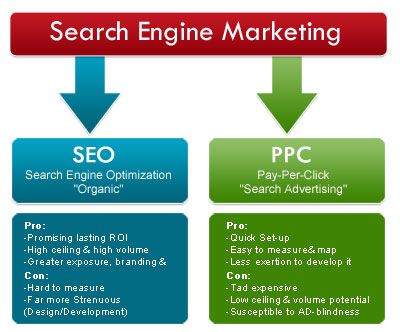
Here’s a simple breakdown of the key differences:
| Feature | SEO (Organic Search) | SEM/PPC (Paid Search) |
| Cost | “Free” (but requires time & resources) | Pay-Per-Click (direct cost) |
| Time to Results | Long-term (months to years) | Immediate (minutes to hours) |
| Position on SERP | Below the ads | Top of the page (ad-labeled) |
| Traffic Longevity | Lasting (if maintained) | Stops as soon as you stop paying |
How Paid SEM Works: A 2-Minute Guide to the Ad Auction
Have you ever wondered how Google decides which ad gets the top spot?
It’s not just given to the highest bidder. Instead, every time someone searches, Google runs a lightning-fast Ad Auction to decide which ads to show and in what order.
This auction is based on two primary factors:
- Your Bid (Max CPC): This is the maximum amount you are willing to pay for a single click.
- Your Quality Score (1-10): This is Google’s rating of how relevant and high-quality your ad, keywords, and landing page are. A high Quality Score is Google’s way of saying your ad is a good match for the user’s search.
These two factors are put into a simple formula to create your Ad Rank, which ultimately determines your ad position.
Ad Rank = Your Max CPC Bid × Your Quality Score
The ad with the highest Ad Rank gets the top position, the one with the second-highest Ad Rank gets the second position, and so on.
Here’s the analogy: Think of the Google Ad Auction as a private club.
- Your Bid is the cover charge you’re willing to pay.
- Your Quality Score is your dress code.
You can’t just pay your way in; if you show up with a low-quality, irrelevant ad (a bad “dress code”), you might not get in at all. Conversely, someone with a fantastic Quality Score (a perfect “dress code”) can often get a better spot than someone else, even while paying less.
The 5 Pillars of a Successful SEM Strategy
A strong SEM campaign isn’t built on luck; it’s built on a strategic framework. Forget simple “components”—think of these as the five essential pillars that hold your entire strategy up. Get one wrong, and the whole thing can wobble.
Pillar 1: Strategic Keyword Research
This is the foundation. It’s not just about what people search, but why they are searching. You must master search intent.
- Informational Intent (“Learn”): Keywords like “what is SEM” or “how does PPC work.” These users are looking for information, not to buy. They are great for blog posts.
- Commercial Intent (“Buy”): Keywords like “best SEM course” or “digital marketing certification.” These users have their wallets out. These are the keywords you want to bid on for your product pages.
A successful strategy targets the right intent at the right time.
Pillar 2: Targeted Ad Groups
Do not dump 100 different keywords into one ad group. This is the most common and costly mistake beginners make.
An ad group is a container that holds a small set of highly related keywords and the ads that go with them.
- Bad Structure:
- Ad Group: “Marketing”
- Keywords: “sem course,” “what is seo,” “social media manager,” “google ads help”
- Good Structure:
- Ad Group 1: “SEM Courses”
- Keywords: “best sem course,” “sem certification,” “paid search training”
- Ad: “Enroll in Our Top-Rated SEM Course.”
- Ad Group 2: “SEO Courses”
- Keywords: “learn seo,” “seo certification,” “seo basics course”
- Ad: “Master SEO with Our Beginner’s Course.”
- Ad Group 1: “SEM Courses”
Rule of Thumb: Create small, tight-knit groups of 5-15 keywords that share the same theme. This allows you to write a super-relevant ad (Pillar 3) that links to a super-relevant landing page (Pillar 4).
Pillar 3: Compelling Ad Copy
Your ad is your digital billboard. With Google’s Responsive Search Ads, you don’t write one static ad. Instead, you provide a list of “ingredients” and let Google’s AI find the best-performing combination.
You provide:
- Up to 15 Headlines (30 characters each): Include your keywords, benefits, and trust signals (e.g., “Top-Rated Course,” “Enroll Today”).
- Up to 4 Descriptions (90 characters each): Add more detail, features, and a strong Call-to-Action (CTA).
A great ad must match the keyword’s intent and have a clear, powerful CTA (e.g., “Get a Free Demo,” “Download the Guide,” “Shop Now”).
Pillar 4: High-Conversion Landing Pages
This is the most overlooked pillar. You can have the best keywords and a perfect ad, but if you send that traffic to your generic homepage, you will waste your money.
A landing page is a specialized, standalone page designed for one single purpose: conversion. It must have:
- Message Match: The headline of your landing page must directly match the promise of your ad. If your ad says “Get a Free SEM Guide,” the landing page must say “Get Your Free SEM Guide Here.”
- A Single Call-to-Action (CTA): Have one clear button (“Download Now,” “Sign Up”).
- No Distractions: Remove your website’s main navigation menu, footer links, and any other “leaks” that would let the user click away.
Pillar 5: Smart Bidding & Budgeting
Finally, you need to manage your money.
- Daily Budget: This is a cap, not a target. It’s the maximum amount you are willing to spend per day on a campaign.
- Bidding Strategy: This is how Google spends your money. The two most common strategies are:
- Maximize Clicks: You tell Google, “Get me the most possible clicks for my daily budget.” This is great for new campaigns when you need to gather data quickly.
- Maximize Conversions: You tell Google, “Get me the most possible conversions (e.g., leads or sales) for my daily budget.” This strategy relies on AI and works best after your campaign has at least 30 conversions in a 30-day period.
How to Launch Your First SEM Campaign (7-Step Guide)
This is the actionable, step-by-step process to take you from zero to a live, running SEM campaign.
Step 1: Set Your Goal
Before you do anything, you must define success. What is the one single goal for this campaign? Don’t try to do everything. Be specific. Your goal will determine your entire strategy.
- Brand Awareness: You want as many people as possible to see your brand name.
- Leads: You want to capture contact information (email, phone) for your sales team.
- Sales: You want users to buy a product or service directly from your website.
Step 2: Choose Your Platform
While there are many SEM platforms, the choice for a beginner is simple.
- For 90% of beginners, the answer is Google Ads. It’s the largest, most popular, and most powerful search ad platform in the world.
- Microsoft (Bing) Ads is a great secondary option, often with lower costs, but you should start with Google.
Step 3: Set Your Budget
Never spend money you can’t afford to lose, especially while learning.
- Decide on a daily budget. This is a cap on what you’re willing to spend each day. You could start with as little as $10-$20/day.
- Be prepared to “buy data.” Your first week or two of spending is not about getting sales; it’s about gathering data on what works and what doesn’t. Be comfortable losing 100% of this initial budget as a “tuition fee” for learning about your market.
Step 4: Do Your Keyword Research
This is the most critical step. You need to find the keywords that your ideal customers are typing into Google.
- Use the Google Keyword Planner (free inside your Google Ads account).
- Focus on “commercial intent.” Look for keywords that signal someone is ready to buy, not just learn.
- Informational Intent: “what is digital marketing”
- Commercial Intent: “best digital marketing course,” “digital marketing certification,” “hire digital marketer”
- A good clue for commercial intent is a high “Top of page bid (high range)” in the planner. It means other businesses are willing to pay a lot for that keyword, likely because it converts.
Step 5: Create Your Campaign & Ad Groups
Structure is key to success and a good Quality Score.
- Campaign: This is the highest-level container. Set your budget and location targeting (e.g., “India,” “New York”) here.
- Ad Groups: Inside your campaign, create small, themed ad groups based on your keyword research. A good ad group has 5-15 highly related keywords.
- Bad: A single ad group with “sem course,” “seo course,” and “social media course.”
- Good: Three separate ad groups, one for each course.
Step 6: Write Your Ads & Create Your Landing Page
- Write Your Ads: Inside each ad group, write 2-3 ad variations that are highly relevant to the keywords in that group. If the user searches for “SEM Course,” your ad headline should say “SEM Course” (Pillar 3).
- Create Your Landing Page: This is the most important part (Pillar 4). Do not send ad traffic to your homepage. Create a dedicated landing page for each ad group that matches the ad’s promise.
Step 7: Launch, Track & Optimize
- Launch: Set your campaign live!
- Track: The first thing you must do is link your Google Ads account to your Google Analytics account. This lets you see what users do after they click your ad.
- Optimize: This is the most important ongoing job.
- Go to the “Search Terms” report in Google Ads. This report shows you the exact phrases people typed that triggered your ad.
- Find irrelevant searches. For example, you might be bidding on “digital marketing course” but find you’re paying for clicks from “free digital marketing course.”
- Add “free” as a Negative Keyword. This tells Google to stop showing your ad for any search that includes the word “free.”
- Repeat this process daily. This is the #1 way to stop wasting money and improve your campaign’s profitability.
This 7-step process is just the beginning. To truly master the auction, optimization, and advanced strategies, you need expert guidance.
Ready to become an expert? Check out our Certified Search Engine Marketing (SEM) Course.
Beyond Google: The Top SEM Platforms to Master
While Google is the undisputed king of search, a smart SEM strategy uses the right platform for the right audience. Limiting yourself to Google means you’re missing out on key demographics and high-intent buyers.
Here are the top platforms you need to master.
1. Google Ads
This is the king, the-non-negotiable center of the SEM world. It has the largest reach and the most powerful data.
- What it is: The paid advertising platform for Google’s entire ecosystem.
- Key Formats:
- Search Ads: The classic text ads that appear at the top of Google search results.
- Display Ads: Visual banner ads that appear across millions of websites in the Google Display Network.
- YouTube Ads: Video ads that run on the world’s second-largest search engine.
- Performance Max (PMax): The new, AI-driven campaign type. You give Google your goals, budget, and creative “assets” (text, images, video), and its AI automatically runs your ads across all of its properties (Search, Display, YouTube, Gmail, Discover, and Maps) to find the most conversions.
2. Microsoft (Bing) Ads
This is the most overlooked and undervalued opportunity in SEM. While it has a smaller search volume, it has a distinct and valuable audience.
- What it is: The ad platform for the Microsoft Search Network (which includes Bing, Yahoo!, and DuckDuckGo).
- Unique Advantage:
- Lower CPC: Because there is less competition, the Cost-Per-Click (CPC) is often significantly lower than on Google. You can get more for your money.
- Different Demographics: The Bing user is typically older, more affluent, and more B2B-focused. It’s the default search engine on most work computers, making it perfect for reaching professionals and decision-makers.
3. Amazon Advertising
This is not a traditional search engine; it’s a “search engine for products.” For any e-commerce brand, this platform is non-negotiable.
- What it is: An internal PPC platform where brands pay to have their products appear at the top of search results and on competitor product pages, inside Amazon.
- Unique Advantage: You are capturing users at the absolute final moment of their purchase journey. They are not researching a purchase; they are on Amazon with their credit card in hand, ready to buy. You are bidding for the “buy box.”
4. YouTube Ads
YouTube is the world’s second-largest search engine. People search for “how-to” guides, reviews, and entertainment. It’s a key platform for both brand awareness and direct response.
- What it is: The video advertising platform for YouTube.
- Key Formats to Know:
- In-Stream Ads: These are the ads that play before, during, or after another video (interrupting the content). They can be Skippable (after 5 seconds) or Non-Skippable.
- In-Feed Ads: These ads (formerly called “Discovery Ads”) appear in places of discovery. You’ll see them in the YouTube search results or as a “recommendation” on the homepage or next to a related video. They consist of a thumbnail and text, inviting the user to click to watch the video.
Attend Live Orientation Session
How to Know if Your SEM is Working: 5 Key Metrics to Track
Running an SEM campaign without tracking metrics is like driving with your eyes closed. You’re spending money, but you have no idea if you’re on the right road, how fast you’re going, or if you’re about to crash.
These five key metrics are your dashboard. They tell you exactly what’s working, what’s broken, and how to improve.
1. Click-Through Rate (CTR)
- What it is: The percentage of people who see your ad (impressions) and then click on it.
- Why it matters: This is your ad’s primary “relevance” score. A high CTR is a sign that your ad copy, keywords, and offer are a perfect match for what the user is searching for.
- Pro-Tip: A high CTR is a huge component of your Quality Score. Google rewards this relevance by giving you a better Ad Rank and, in turn, a lower Cost-Per-Click (CPC)!
2. Cost-Per-Click (CPC)
- What it is: The average amount you pay every time someone clicks on your ad.
- Why it matters: This metric is the core of your budget. If your average CPC is $5, a $500/day budget gets you 100 clicks. If your CPC is $2, it gets you 250 clicks. Your goal is to get your CPC as low as possible while still attracting high-quality, relevant visitors.
3. Conversion Rate
- What it is: The percentage of people who clicked your ad and then completed your desired goal (e.g., filled out a form, bought a product, or signed up for a newsletter).
- Why it matters: This metric is the ultimate test of your landing page and offer. You can have a 50% CTR, but if your landing page is confusing and your conversion rate is 0%, you are wasting 100% of your money. This metric separates traffic from business results.
4. Cost-Per-Acquisition (CPA)
- What it is: The total amount you spent divided by the total number of conversions. This is also known as Cost-Per-Conversion.
- Why it matters: This is your “cost per result.” It answers the critical business question: “How much did it cost me to get one lead?” or “How much did I pay to get one sale?” Knowing your target CPA (e.g., “I am willing to pay up to $50 for a qualified lead”) is the key to managing your budget and scaling your campaigns profitably.
5. Return on Ad Spend (ROAS)
- What it is: The most important metric, especially for e-commerce. For every $1 you spend on ads, how many dollars in revenue do you get back? The formula is
(Total Revenue from Ads / Total Ad Spend). - Why it matters: This is your ultimate measure of profitability. A CPA tells you your cost, but ROAS tells you your return. If you spend $1,000 on ads and generate $5,000 in sales, your ROAS is 5x (or 500%). This single number tells your CEO whether your SEM strategy is a profit-center or a cost-center.
Conclusion: Your Launchpad for Search Dominance
Search Engine Marketing is not a single tool; it’s a complete toolkit for getting found online. We’ve demystified the confusion: SEM is the umbrella, SEO is your long-term, “owned” asset, and PPC is your fast-acting, “rented” visibility.
You no longer have to choose between them. A winning strategy uses both:
- PPC gives you immediate data and market feedback. It tells you right now which keywords convert and which ad copy works.
- SEO takes that data and uses it to build a long-term, profitable, and sustainable engine that brings in “free” traffic long after your ad budget is turned off.
By understanding the five pillars—from keyword intent and ad groups to high-converting landing pages—you’ve moved beyond just “what is SEM?” You now have the foundational strategy to launch, measure, and optimize. The next step is to put it into action.
Frequently Asked Questions (FAQs)
1. What’s the real difference between SEM, SEO, and PPC?
This is the most common point of confusion. Here’s the simple breakdown:
- SEM (Search Engine Marketing): This is the umbrella term for all marketing activities on a search engine, both paid and unpaid.
- SEO (Search Engine Optimization): This is the unpaid (organic) part of SEM. It’s the practice of building your site’s quality and authority to rank on Google “for free.”
- PPC (Pay-Per-Click): This is the paid part of SEM. You are paying Google (or Bing, etc.) to place your ad at the top of the results.
Over time, many people have started to use “SEM” as a synonym for “PPC.” While technically incorrect, it’s very common.
2. How long does it take to see results from SEM?
It depends on which part of SEM you’re talking about:
- PPC (Paid): You can see results almost immediately. You can launch a campaign and have your ad at the top of Google within an hour, driving traffic and (hopefully) conversions the same day.
- SEO (Organic): This is a long-term strategy. It typically takes 3 to 6 months of consistent effort to start seeing meaningful, lasting results and to climb in the rankings for competitive keywords.
3. How much does SEM cost for a beginner or small business?
There are two costs:
- Ad Spend: This is what you pay Google for the clicks. You can set your own budget. A small business might start with a $10-$20/day budget to gather data.
- Management Fee: This is what you pay an agency or freelancer to manage your campaigns. (If you learn to do it yourself, this cost is $0).
A small business can realistically start testing the waters with a total budget of $500 – $1,000 for the first month (Ad Spend + Management or a training course).
4. Is SEM a good career?
Yes, it’s one of the most in-demand and future-proof skills in digital marketing. Every business needs to be found on Google, and “Performance Marketing” (SEM/PPC) specialists are the ones who manage the budgets and deliver a measurable ROI. It’s a highly analytical, strategic, and well-paid career path.
5. Can I learn SEM for free?
Absolutely. You can get 100% of the knowledge for free, but you will pay for it with your time.
- Google Skillshop: Google provides free, in-depth training and certifications for Google Ads.
- Industry Blogs: Websites like Search Engine Land, WordStream, and HubSpot provide endless free guides.
- Digital Vidya’s Blog: Our blog is a key resource for practical, up-to-date guides (like the one you’re reading!).
The advantage of a paid course is a structured, fast-tracked path with mentorship, which saves you time and helps you avoid costly beginner mistakes.
6. What kind of businesses should use SEM?
Any business that wants to increase its visibility on search engine results pages and generate leads can use SEM. SEM can be an effective marketing strategy for small businesses to large enterprises.
7. What are the SEM certifications available?
Various SEM certifications are available from organizations such as Google, Bing, Digital Vidya, Yahoo, etc. These certifications can help you learn more about SEM and how to use it effectively for your business.
8. What is the future of SEM?
The future of SEM looks promising as more businesses are turning to SEM to increase their visibility on search engine results pages and generate leads. With the right strategy, SEM can be a powerful marketing tool for businesses of all sizes.