Are you ready to prove you can handle the marketing landscape of 2025?
Gone are the days when defining “SEO” or “PPC” was enough to land a job. In 2025, hiring managers aren’t just looking for textbook definitions; they are testing your ability to navigate Google Analytics 4 (GA4), optimize for AI Search (SGE), and calculate real-world ROAS.
Whether you are a fresh graduate facing your first panel or a seasoned expert aiming for a managerial role, this guide is your cheat sheet. We have curated the top 100+ digital marketing interview questions, strictly categorized to help you prepare faster.
What’s Inside This Guide?
We’ve moved beyond the basics to include the “Scenario-Based” questions that trip up most candidates.
- For Freshers: foundational concepts, vocabulary, and “Why Digital Marketing?” answers.
- For Experts: Advanced technical SEO, data attribution models, and team leadership scenarios.
- For Everyone: The impact of AI tools (ChatGPT, Jasper) on modern marketing workflows.
Pro Tip: Don’t just memorize answers. Use our “Star Method” tips to structure your responses: Situation, Task, Action, and Result.
Digital Marketing Interview Questions for Freshers
(Focus: Core Definitions, Career Motivation, and 2025 Basics)
For freshers, interviewers aren’t expecting you to be a Google Ads expert yet. They are testing three things: Curiosity, Clarity of Concepts, and Communication.
Q1. In simple terms, what is Digital Marketing?
The Rookie Answer: “It is marketing products using the internet like Facebook and Google.” The 2025 Winning Answer:
“Digital Marketing is the art of promoting brands and selling products through online channels like Search Engines, Social Media, and Email. Unlike traditional marketing (TV/Print), digital marketing is data-driven and measurable—we can track every click, view, and rupee spent to calculate exact returns.”
Q2. Why do you want to start a career in Digital Marketing?
Why they ask: To see if you are serious or just looking for any job. Best Approach: Combine “Creativity” with “Data.”
Sample Answer: “I am attracted to this industry because it is one of the few fields that blends creativity (writing ad copies, designing visuals) with analytical logic (reading data, optimizing budgets). I don’t just want to create campaigns; I want to see the real-time impact of my work on a business’s growth. Plus, the industry evolves every day—like the recent shift to AI—which keeps the work exciting.”
Q3. What is the difference between SEO and SEM?
This is a classic question. Use a comparison table for a quick, sharp answer.
| Feature | SEO (Search Engine Optimization) | SEM (Search Engine Marketing) |
| Cost | “Free” (Organic/Earned traffic) | Paid (Pay-Per-Click/PPC) |
| Speed | Slow (Takes 3-6 months to rank) | Instant (Immediate visibility) |
| Sustainability | Long-term results (Lasts after you stop working) | Short-term (Traffic stops when budget stops) |
| Example | Ranking #1 for a blog post naturally. | Clicking a “Sponsored” link at the top of Google. |
Q4. Can you explain the “Digital Marketing Funnel”?
The Concept: The journey a stranger takes to become a loyal customer.
“The funnel describes the customer’s journey in four stages:
- Awareness: The user sees our ad or blog (e.g., ‘What is best running shoe?’).
- Interest: They browse our products and read reviews.
- Desire: They add a product to the cart.
- Action: They make the payment. My job as a marketer is to move people from the top (Awareness) to the bottom (Action) without losing them.”
Q5. What are the most critical Digital Marketing acronyms I should know?
(Interviewer Note: If you don’t know these, you will struggle in the daily workflow.)
- PPC (Pay-Per-Click): You pay a fee each time one of your ads is clicked.
- CTR (Click-Through Rate): The percentage of people who saw your ad and actually clicked on it.
- CTR = {Total ClicksTotal Impressions}100
- CTA (Call-to-Action): The instruction you give the user (e.g., “Buy Now,” “Sign Up,” “Learn More”).
- KPI (Key Performance Indicator): A metric used to measure success (e.g., Total Sales, Cost Per Lead).
- ROI (Return on Investment): The profit you made compared to how much you spent.
Q6. What is the difference between Inbound and Outbound Marketing?
“Think of Outbound as using a megaphone—you interrupt people to show them ads (TV ads, Cold calling). Inbound is like a magnet—you create helpful content (Blogs, YouTube videos) that solves their problems, so they come looking for you.”
Pro Tip for Freshers: “The Red Flag Answer”
⚠️ Never say: “I want to do digital marketing because I spend a lot of time on Instagram/Reels.” Why? Scrolling social media is consumption. Digital marketing is creation and distribution. Instead, mention a specific creator strategy you analyzed or a small page you tried to grow.
SEO Specialist Interview Questions (Technical & Strategy)
(Focus: Technical SEO, Ranking Factors, and AI Adaptation)
SEO is no longer just about keywords; it is about User Experience (UX) and Authority. Interviewers for this role will test your technical competence and your ability to adapt to Google’s ever-changing algorithm.
Q7. What is the difference between On-Page and Off-Page SEO?
The Simple Answer: On-Page is what you do on your site; Off-Page is what happens elsewhere. The Expert Answer:
“On-Page SEO involves optimizing elements within your control to improve rankings. This includes Meta tags, content quality, internal linking, image alt text, and page speed (Core Web Vitals).
Off-Page SEO focuses on increasing the authority of your domain through external signals. This isn’t just “backlinks”; it includes Social Media signals, Brand Mentions (unlinked mentions), Local Citations, and Digital PR.”
Q8. How do you approach Keyword Research in 2025?
Why they ask: To see if you still rely on just “search volume.” Best Approach: Focus on Search Intent.
“I don’t just look for high-volume keywords. I categorize keywords by User Intent:
- Informational: ‘How to clean white shoes’ (Blog content)
- Transactional: ‘Buy white Nike running shoes’ (Product page)
- Navigational: ‘Nike login’
In 2025, matching the intent is more important than keyword density. I use tools like Semrush or Ahrefs to find long-tail opportunities and analyze the ‘People Also Ask’ section to structure my content.”
Q9. What are Core Web Vitals? (Critical Technical Question)
(Note: If you mention FID, you are outdated. In March 2024, Google replaced FID with INP.)
“Core Web Vitals are a set of metrics Google uses to measure real-world user experience. The three main pillars are:
- LCP (Largest Contentful Paint): Measures Loading performance. (How fast the main image/text loads).
- CLS (Cumulative Layout Shift): Measures Visual Stability. (Does the page jump around while loading?).
- INP (Interaction to Next Paint): Measures Interactivity. (How quickly the browser responds when a user clicks a button). Note: INP replaced FID as the official metric.“
Q10. What is a Canonical Tag and why is it used?
The Scenario: You have two pages with identical content (e.g., a product page with different color filters).
“A Canonical Tag (
rel=canonical) is a snippet of HTML code that tells search engines which version of a page is the ‘master’ or ‘preferred’ version.Why it matters: It prevents Duplicate Content issues. If I have 3 URLs showing the same T-shirt, Google might dilute the ranking power across all 3. The canonical tag focuses all that ranking power onto the main URL.”
Q11. How does AI Search (Google SGE / AI Overviews) impact SEO strategy?
The Trend Question: This shows you are future-proof.
“With Google’s AI Overviews taking up the top of the SERP (Search Engine Results Page), ‘Zero-Click’ searches are increasing. To survive this, my strategy shifts to:
- Optimizing for ‘Answer Engine’ formats: Using clear lists, tables, and direct answers in the first 100 words of content.
- Building Brand Authority: AI prioritizes trusted sources. We need high-quality backlinks and E-E-A-T (Experience, Expertise, Authoritativeness, Trustworthiness).
- Focusing on Deep-Dive Content: AI answers simple questions. We must write complex, experience-based content that AI cannot easily summarize.”
Q12. What is the difference between a ‘Do-Follow’ and ‘No-Follow’ link?
“A Do-Follow link passes ‘link juice’ (authority) from one site to another, directly helping SEO rankings. A No-Follow link (
rel="nofollow") tells Google not to pass authority.
- When to use No-Follow: For paid links, sponsored posts, or user-generated comments (to prevent spam).”
PPC & Google Ads Interview Questions (Intermediate)
(Focus: ROI, Bidding Strategies, and Troubleshooting)
Hiring managers ask these questions to ensure you won’t waste their budget. They want to know if you understand the value of money and how to fix a campaign when it starts losing money.
Q13. What is Quality Score and why is it the “Holy Grail” of PPC?
The Concept: It is Google’s rating (1-10) of the quality and relevance of your keywords and PPC ads.
Answer: “Quality Score is critical because it directly affects how much we pay per click (CPC). A higher score means we pay less to rank higher than our competitors. It is calculated based on three factors:
- Expected CTR: How likely users are to click our ad.
- Ad Relevance: Does the ad copy match the user’s search query?
- Landing Page Experience: Is the page fast, mobile-friendly, and relevant? If my CPC is too high, the first thing I check is Quality Score.”
Q14. Search Network vs. Display Network: When do you use which?
Use this comparison to show you understand User Intent.
| Feature | Search Network (Pull) | Display Network (Push) |
| User Mindset | Active Intent (They are looking for a solution now). | Passive (They are browsing news/blogs, not looking to buy). |
| Best For | Capturing Leads, Sales, “Emergency” services. | Brand Awareness, Retargeting (reminding them to buy). |
| Example | User types “Best CRM software” on Google. | User sees a banner ad for CRM software while reading Forbes. |
Q15. Explain the “Broad Match + Smart Bidding” strategy (2025 Trend).
Why they ask: This tests if you are up-to-date with modern Google best practices.
Answer: “In the past, we avoided Broad Match keywords because they were too loose. But in 2025, the ‘Power Pair’ is Broad Match keywords combined with Smart Bidding.
- Broad Match gives the AI a wide net to find relevant queries we didn’t think of.
- Smart Bidding (like Target CPA) uses millions of signals to filter those queries and only bids when the user is likely to convert.It allows us to scale campaigns without losing efficiency.”
Q16. What is a Performance Max (PMax) Campaign?
“Performance Max is Google’s goal-based, all-in-one campaign type. Instead of creating separate Search, Display, and YouTube campaigns, I provide one set of assets (images, videos, headlines), and Google’s AI automatically serves ads across all Google inventory (YouTube, Search, Gmail, Maps, Discover) to find the best conversions.”
Q17. Scenario: Your client’s Cost Per Lead (CPL) suddenly doubled yesterday. What do you do?
This is the #1 “Troubleshooting” question.
The 3-Step Investigation:
- Check the ‘Search Terms’ Report: Did we start appearing for irrelevant searches? (If yes, add Negative Keywords).
- Check Auction Insights: Did a new competitor enter the market and drive up bids?
- Check the Landing Page: Is the site loading slowly or is the form broken? (A broken form means clicks happen, but no leads, skyrocketing the CPL).”
Q18. What is the difference between ROAS and ROI?
- ROAS (Return on Ad Spend): Measures gross revenue from ads.
- Formula: Revenue / Ad Spend
- Use: To check if ads are effective day-to-day.
- ROI (Return on Investment): Measures true business profit.
- Formula: (Net Profit / Total Cost) / 100
- Use: To check if the business is actually making money after paying for product costs, agency fees, and tools.
Pro Tip: The “Red Flag” Answer for PPC
⚠️ Never say: “I can guarantee a #1 ranking on Google Ads.”
Why? Ad Rank is dynamic. It changes every auction based on competitor bids and quality scores. No ethical marketer guarantees a permanent #1 spot.
Social Media & Content Marketing Interview Questions
(Focus: Engagement, Virality, and Crisis Management)
Any fresher can post a Reel. A professional knows why that Reel drives revenue. These questions test your ability to move beyond “likes” and focus on business growth.
Q19. What is the difference between “Vanity Metrics” and “Actionable Metrics”?
The Trap: Many candidates think “Likes” are the most important metric.
Answer: “Vanity Metrics look good on paper but don’t prove business value (e.g., Likes, Followers, Page Views).
Actionable Metrics prove that the user is actually interested or buying (e.g., Conversion Rate, Click-Through Rate (CTR), Engagement Rate, and Saves/Shares).
- Example: A post with 10,000 likes but 0 clicks is vanity. A post with 100 likes and 20 sales is actionable.”
Q20. How do you calculate Engagement Rate? (2025 Standard)
Note: Don’t just say “likes plus comments.” Give the formula.
“I use the standard formula to measure true impact relative to reach:
Engagement Rate= {(Likes + Comments + Shares + Saves)Total Reach} * 100
In 2025, I prioritize ‘Saves’ and ‘Shares’ over Likes because the algorithm treats them as high-intent signals, boosting the post’s virality.”
Q21. What is your strategy for “Short-Form Video” (Reels/Shorts/TikTok)?
The Strategy Answer: Don’t just say “Use trending audio.” Use the H-V-C Framework.
“My strategy relies on the H-V-C structure to retain attention:
- Hook (0-3 seconds): A visual or audio trigger to stop the scroll (e.g., ‘Stop making this SEO mistake’).
- Value (3-50 seconds): The core educational or entertaining content.
- Call-to-Action (Last 5 seconds): A clear instruction (e.g., ‘Read the caption for the prompt’).I also strictly monitor ‘Watch Time’—if retention drops at 5 seconds, I know my hook worked but my content failed.”
Q22. Scenario: A customer posts a viral angry tweet about your brand. How do you handle the crisis?
The “PR Disaster” Test.
The 3-A Response Protocol:
- Acknowledge (Publicly): Reply immediately (within 1 hour) on the same platform. “We hear you, and we are sorry this happened.” Do not delete the comment unless it is abusive.
- Act (Privately): Move the conversation to DM/Email. “Please DM us your order ID so we can fix this immediately.”
- Analyze (Internally): After resolving, investigate why it happened to prevent a repeat.Key Rule: Never argue with a customer publicly. It always makes the brand look petty.”
Q23. How do you ensure Influencer Marketing compliance?
“In 2025, transparency is non-negotiable.
- Global/US: We must follow FTC guidelines by ensuring influencers use
#Ador#Sponsored.- India (ASCI): We must ensure the ‘Paid Partnership’ label is active on Instagram/YouTube.Hidden ads can lead to heavy fines and loss of brand trust, so I verify every contract for these disclosure clauses.”
Pro Tip: The “Red Flag” Answer for Social Media
⚠️ Never say: “My strategy is to post 3 times a day on every platform.”
Why? This is the “Spray and Pray” method. It leads to burnout and low-quality content. Instead, say: “I focus on repurposing one high-quality piece of content across platforms native to their specific formats.”
Technical & Data Analytics Interview Questions
(Focus: GA4, Attribution, and Tracking Strategy)
In 2025, marketing is math. Interviewers need to know if you can read the data to tell them where their money is going and how to optimize it.
Q24. What is the fundamental difference between Universal Analytics (UA) and Google Analytics 4 (GA4)?
The “Must-Know” Answer:
“The core difference is the Data Model.
- Universal Analytics was Session-Based (focused on visits).
- GA4 is Event-Based (focused on user actions). In GA4, everything is an event—a page view, a click, a file download, or a video start. This allows us to track the user journey more accurately across websites and apps combined.”
Q25. Explain “Attribution Models.” Which one do you prefer?
The Concept: Attribution assigns “credit” to the different marketing channels that led to a sale. The 2025 Answer:
“There are several models, but Data-Driven Attribution is the current standard in GA4.
- Last Click: Gives 100% credit to the very last ad clicked. (Problem: It ignores the blog post or social ad that introduced the brand).
- Linear: Splits credit equally across all touchpoints.
- Data-Driven (Preferred): Uses AI to analyze the conversion path and assigns credit based on the actual impact of each touchpoint. I prefer this because it shows the true value of top-of-funnel awareness campaigns.”
Q26. What is Cross-Domain Tracking and when do you need it?
The Scenario: You have a main website (example.com) and a separate cart hosted on Shopify (shop.example.com).
“Cross-Domain Tracking connects two different websites so GA4 sees them as one single session from one user, rather than two separate users. Without this configuration, when a user moves from the blog to the shop, the session breaks, the original traffic source (e.g., Facebook Ad) is lost, and the sale is incorrectly attributed to ‘Direct/None’.”
Q27. What happened to “Bounce Rate” in GA4?
The “Update” Test:
“In the old UA, Bounce Rate measured users who left without interacting. It was often misleading (e.g., a user reads a whole blog and leaves satisfied, but counts as a ‘bounce’). In GA4, the focus shifted to Engagement Rate. An ‘Engaged Session’ is a session that lasts longer than 10 seconds, has a conversion event, or has 2+ page views. It is a much healthier metric to measure content quality.”
Q28. What are UTM Parameters?
“Urchin Tracking Module (UTM) parameters are tags added to the end of a URL to track exactly where traffic comes from.
- Structure:
?utm_source=facebook&utm_medium=cpc&utm_campaign=summer_sale- Why critical: Without UTMs, traffic from newsletters, social posts, or QR codes often gets lumped into ‘Direct Traffic,’ making it impossible to calculate ROI.”
Pro Tip: The “Red Flag” Answer for Analytics
⚠️ Never say: “I don’t handle the tracking codes; I just look at the dashboard.” Why? Even if you aren’t a developer, a digital marketer must know how to generate a UTM link or check if a pixel is firing using the Google Tag Assistant Chrome extension. Ignorance of setup leads to bad data.
AI in Digital Marketing Interview Questions (2025 Trends)
(Focus: Prompt Engineering, Ethics, and Workflow Integration)
Hiring managers in 2025 are terrified of “lazy” marketers who just copy-paste from AI. They want to know if you can tame the AI to produce high-quality, legal, and effective work.
Q29. How do you use ChatGPT / AI tools for SEO without getting penalized?
The “Safe” Answer:
“I use AI as a ‘Junior Assistant,’ not the ‘Writer.’
- Good Use: I use it for keyword clustering, generating schema markup code, creating content outlines, and brainstorming 10 variations of a headline.
- Bad Use: I never copy-paste whole articles because AI content often lacks ‘Information Gain’ (new insights) and can hallucinate facts. Google rewards E-E-A-T (Experience), which AI cannot provide. My workflow is: AI for structure -> Human for writing & examples -> AI for proofreading.”
Q30. What is “Programmatic SEO” and how does AI help?
The Advanced Strategy Question:
“Programmatic SEO is the method of creating hundreds of landing pages at scale using a database and a template (e.g., TripAdvisor has a page for ‘Hotels in [City]’ for every city on earth).
- In 2025: I can use AI to write unique descriptions for each of those 500 pages based on data points (e.g., weather, price, population) so they don’t look like duplicate content. It turns a 6-month project into a 2-week project.”
Q31. How do you handle the legal/ethical risks of AI-generated images (Midjourney/DALL-E)?
The Compliance Test:
“The biggest risk is Copyright. Currently, the US Copyright Office says purely AI-generated art cannot be copyrighted.
- My Protocol: I avoid using AI images for ‘Hero’ brand assets (like logos) where we need ownership. For blog images or social posts, I ensure we have a ‘Disclosure Policy’ (labelling content as AI-generated where required) to maintain trust with our audience and avoid future legal backlash.”
Q32. What is the difference between a “Zero-Shot” and “Few-Shot” prompt?
The Technical “Prompt Engineering” Question:
“This refers to how much context you give the AI.
- Zero-Shot: Asking without examples. (e.g., ‘Write a tweet about shoes.’) -> Result is usually generic.
- Few-Shot: Giving examples of the desired output. (e.g., ‘Here are 3 examples of our brand’s funny tone. Write a tweet about shoes in this style.’) -> Result is highly usable. I always use Few-Shot prompting to ensure the AI matches our brand voice.”
Q33. Scenario: Your boss wants to replace the content team with AI to save money. What do you say?
The “Strategic Pushback” Answer:
“I would explain that AI lowers the ‘floor’ of quality, but it lowers the ‘ceiling’ too. If we rely 100% on AI, we will sound exactly like our competitors who are doing the same thing. To win in 2025, we need ‘Commoditized Content’ (definitions, basic emails) done by AI, but ‘Thought Leadership’ (opinion pieces, case studies) done by humans. The savings should come from efficiency, not eliminating the creative brains.”
Pro Tip: The “Red Flag” Answer for AI
⚠️ Never say: “I use AI to write everything because it’s faster.” Why? This implies you don’t care about quality or checking facts. It frames you as lazy rather than efficient.
10 Tough Scenario-Based Interview Questions
(The “Deal Breaker” Section)
This section separates the “Executors” (who just push buttons) from the “Strategists” (who solve business problems). Advice to Candidates: Use the STAR Method (Situation, Task, Action, Result) for every answer.
Q34. Scenario: The “Sales vs. Marketing” War
The Situation: “The Sales Director complains that your marketing leads are ‘junk’ and ‘useless.’ However, your dashboard shows you are hitting all your Lead Gen targets. How do you handle this conflict?”
Interviewer’s Intent: To test your ability to align with sales and define “Quality” vs. “Quantity.”
The Winning Answer: “I would not get defensive. Instead, I would ask for a ‘Feedback Loop’ meeting.
- Audit: I’d ask Sales to tag the ‘junk’ leads in the CRM so I can analyze the source (e.g., maybe one specific Facebook audience is bringing in bad leads).
- Definition: I would redefine ‘MQL’ (Marketing Qualified Lead). Perhaps our current criteria are too loose.
- Action: I would implement a ‘Lead Scoring’ system—only passing leads to sales that have a score of 50+ (e.g., visited pricing page + corporate email), while nurturing the rest via email automation.”
Q35. Scenario: The “Budget Slash”
The Situation: “The CFO cuts your digital marketing budget by 30% due to a financial crunch but expects you to maintain the same number of leads. What is your strategy?”
Interviewer’s Intent: To test your prioritization and efficiency (ROAS) skills.
The Winning Answer: “I would perform a ‘Bottom-Up’ audit of our campaigns.
- Cut the Fat: Pause all ‘Awareness’ and ‘Experimental’ campaigns that don’t bring immediate conversions.
- Focus on High-Intent: Shift the remaining 70% budget strictly to ‘Bottom of Funnel’ keywords (e.g., ‘Buy CRM software’ vs ‘What is CRM’).
- Remarketing: Increase spend on Remarketing lists, as these users convert at a much lower cost (CPA) than cold traffic.”
Q36. Scenario: The “SEO Nightmare” (Core Update)
The Situation: “You wake up, and organic traffic has dropped by 40% overnight. The CEO is panicking. Walk me through your next 24 hours.”
Interviewer’s Intent: To see if you panic or if you have a diagnostic process.
The Winning Answer: “First, I would tell the CEO: ‘Don’t panic, and don’t change anything yet.’ Then, I’d execute a 3-step diagnosis:
- Technical Check: Is the site down? Did someone accidentally add a ‘noindex’ tag? (Check Search Console for Manual Actions).
- Algorithm Check: Did Google release a Core Update yesterday? If yes, we wait 2 weeks for volatility to settle.
- Segment Data: Did we lose traffic on all pages or just specific blog posts? If it’s specific pages, it’s likely a content relevance or ‘Helpful Content’ issue we can fix later.”
Q37. Scenario: The “Ethical Trap”
The Situation: “Your boss suggests buying an email list of 50,000 people to ‘blast’ them with our new offer to get quick sales. What do you say?”
Interviewer’s Intent: To test your integrity and knowledge of spam laws (GDPR/CAN-SPAM).
The Winning Answer: “I would strongly advise against it for two reasons: Reputation and Revenue.
- Legal/Tech: Sending unsolicited emails will spike our ‘Spam Complaint’ rate. This will ruin our domain reputation, causing even our legitimate emails to go to Spam folders.
- Strategy: Cold lists have an abysmal conversion rate. I would suggest taking that budget and running a ‘Lead Magnet’ campaign on LinkedIn instead to build a legitimate, high-intent list.”
Q38. Scenario: The “Attribution Confusion”
The Situation: “Google Ads claims it drove 100 sales. Facebook Ads claims it drove 100 sales. But your backend Shopify only shows 150 total sales. Why is this happening, and how do you report it?”
Interviewer’s Intent: To see if you understand how platforms “steal” credit (Overlap).
The Winning Answer: “This is a classic ‘Double Attribution’ problem. Both platforms are claiming credit for the same user (e.g., User clicked Facebook -> waited 2 days -> Googled us -> Bought).
- The Fix: I would trust the backend data (CRM/Shopify) as the source of truth.
- The Reporting: I would look at GA4’s ‘Cross-Channel Attribution’ report to see the assisted conversions and explain to the client that Facebook likely created the demand while Google captured it.”
Q39. Scenario: The “Viral Vanity” Request
The Situation: “A client wants a video to ‘go viral’ like a competitor’s funny meme video, but they sell B2B industrial software. How do you respond?”
Interviewer’s Intent: Can you say “No” to a bad idea without being rude?
The Winning Answer: “I would validate their desire for visibility but pivot to relevance. ‘I understand we want massive reach. However, if 1 million teenagers watch our video, none of them will buy industrial software. It might actually hurt our algorithm targeting. Counter-Proposal: Let’s create a ‘Solution-Focused’ video targeting CTOs. We might only get 5,000 views, but if 50 of them are qualified leads, the ROI will be significantly higher than a viral meme.’”
Q40. Scenario: The “Cannibalization” Puzzle
The Situation: “We are ranking #1 organically for ‘Best Running Shoes.’ You are also bidding on this keyword in Google Ads. The CEO asks: ‘Why pay for ads if we rank #1 for free? Stop the ads.’ Do you agree?”
Interviewer’s Intent: To test your understanding of SERP real estate and Incrementality.
The Winning Answer: “I would run an ‘Incrementality Test’ before stopping. Often, if we pause the ad, we don’t get 100% of that traffic back organically; competitors might steal the top ad slot and take 30% of our clicks. I would pause the ad for 2 weeks and measure the net drop in total traffic. If the total traffic drops significantly, the ad is worth keeping to dominate the SERP real estate.”
Q41. Scenario: The “Ad Account Ban”
The Situation: “It’s Black Friday week. Your Facebook Ad account gets disabled with no clear reason. What do you do?”
Interviewer’s Intent: Crisis management under extreme pressure.
The Winning Answer: “1. Immediate Appeal: Request a review via the Business Support Home. 2. Diversify Spend (Plan B): While we wait, I would immediately shift the daily budget to our secondary channels (e.g., Google Ads, TikTok, or Email blasts) to ensure we don’t lose Black Friday momentum. 3. Audit: I’d check if a new creative violated a policy (e.g., ‘Before/After’ images or implied attributes) to prevent it from happening again.”
Q42. Scenario: The “AI Quality Control”
The Situation: “Your content team is using ChatGPT to write blogs to save time, but the traffic is flatlining. You suspect the content is the issue. How do you fix it?”
Interviewer’s Intent: Managing AI workflows.
The Winning Answer: “AI content often lacks ‘Information Gain’—it repeats what is already on the web. I would enforce a ‘Human Sandwich’ rule:
- Top: Human creates the strategy and unique angle.
- Middle: AI drafts the body content.
- Bottom: Human adds expert quotes, real-life examples, and proprietary data that AI doesn’t have access to. This signals ‘E-E-A-T’ to Google.”
Q43. Scenario: The “Influencer Disaster”
The Situation: “An influencer we paid $5,000 to posted a video promoting our product, but they forgot to use the #Ad disclosure, and now people are calling us ‘scammers’ in the comments. What do you do?”
Interviewer’s Intent: Compliance and PR damage control.
The Winning Answer: “1. Contact: Immediately ask the influencer to edit the caption to add
#AdorPaid Partnership. 2. Transparency: Reply to the top negative comments from the brand account: ‘Hi, this was indeed a sponsored partnership. We’ve asked the creator to update the tag. Thanks for keeping us accountable!’ This turns a negative into a positive by showing we care about transparency.”
Questions to Ask the Interviewer (Bonus Section)
(How to Close the Interview Like a Pro)
The interview isn’t over when they stop asking questions. It ends when you stop. When the interviewer asks, “Do you have any questions for us?”, saying “No” is a mistake. It suggests you haven’t researched the company or aren’t deeply interested.
Here are 5 “Power Questions” that will leave a lasting impression, categorized by who you are interviewing with.
1. For the Marketing Manager (Strategy Focus)
- Question: “What is the biggest challenge the marketing team is currently facing in hitting its Q4 targets?”
- Why this works: It shifts the conversation from “Me” (the candidate) to “Us” (the team). It positions you as a problem-solver who wants to help immediately.
- Question: “How closely does the marketing team align with the sales team here? Is there a shared feedback loop?”
- Why this works: It shows you understand that marketing exists to drive revenue, not just to make pretty posts.
2. For the CEO / Founder (Vision Focus)
- Question: “I noticed you recently launched [Product X] / expanded to [Region Y]. How does this role support that specific growth goal?”
- Why this works: It proves you did your homework and read the latest company news.
- Question: “How is the company planning to adapt to the rise of AI and ‘Zero-Click’ searches in 2025?”
- Why this works: It shows you are future-proof and thinking about long-term survival.
3. For HR / The Recruiter (Culture Focus)
- Question: “What does ‘success’ look like for this role in the first 90 days?”
- Why this works: It shows you are ambitious and goal-oriented. It also gives you a clear roadmap of what they expect.
⚠️ The “Do Not Ask” List (Red Flags)
Avoid asking these questions in the first round, as they can make you look transactional or unprepared:
- ❌ “What does your company actually do?” (You should already know this.)
- ❌ “How soon can I take a vacation?” (Focus on value first, benefits later.)
- ❌ “Do I have to work weekends?” (Instead ask: “What is the typical work-life balance culture here?”)
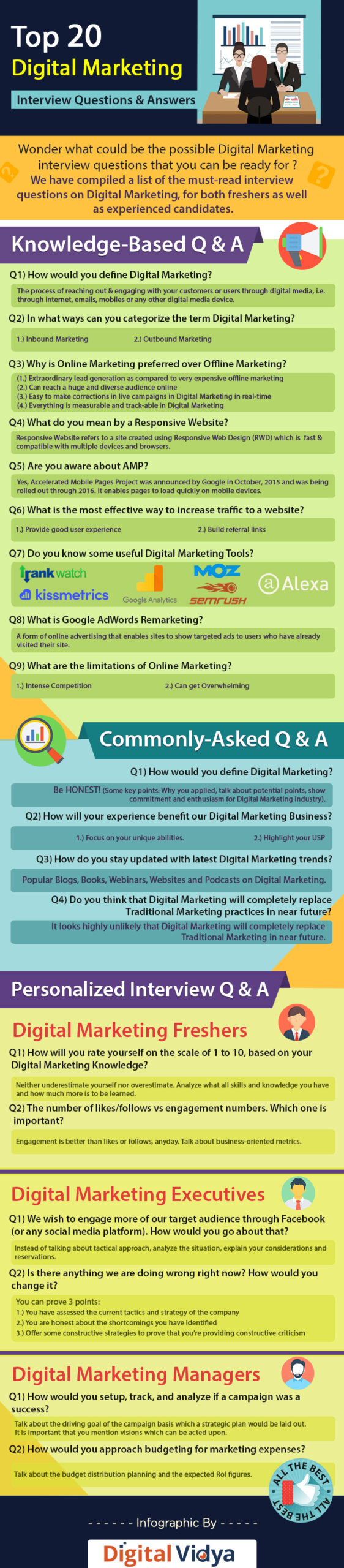
Knowledge-Based Digital Marketing Interview Questions and Answers
If you are looking for a digital marketing job interview, your technical skills, as well as your ability to make a relevant digital marketing strategy to run a result-driven digital marketing campaign, will be tested.
Listed below are some of the basic Digital Marketing Interview questions and answers to assess the foundation of your knowledge about Digital Marketing:
1. How would you define Digital Marketing?
Ans: Digital Marketing is about a brand’s marketing initiatives executed across digital platforms. Digital Marketing is the process of reaching out to and engaging with your customers or users through digital media. Notice the highlights here – reaching out to, and engaging with.
Traditional marketing channels definitely helped immensely in reaching out to the audience but engagement and interaction were largely missing, making it a one-sided communication.
As a marketer, you would agree that effective marketing communication is all about two-way communication, or about having a meaningful dialogue with customers. This is where traditional marketing channels lose Digital Marketing scores.
For any organization or individual who wants to reach out and engage with their customers or prospects, Digital Marketing platforms are of immense use.
And it is not just limited to the sales & marketing efforts of brands but extends to greater pastures of a business like serving customers, finding new talent, Market Research, and needless to mention that various sales & marketing objectives like Lead Generation, brand building, Customer Acquisition could be achieved using Digital Marketing.
Digital Marketing includes multiple channels like social media, search engines, brand websites, content platforms, etc, and could utilize various techniques like Search Engine Monetization (SEM), SEO, Email Marketing, link building, content strategy, content marketing, key areas of site ranking like quality score, successful social media marketing, on & off-page optimization, AdWords ad, etc.
Download Detailed Brochure and Get Complimentary access to Live Online Demo Class with Industry Expert.
2. What is the difference between Inbound and Outbound Marketing? (And how do Performance vs. Brand Marketing fit in?)
The Basic Answer: “Inbound Marketing is a strategy to pull customers in by creating helpful content (Blogs, SEO, Social Media). It solves their problems so they come to you. Outbound Marketing is a strategy to push your message out to a broad audience, often interrupting them (TV Ads, Cold Calls, Display Banners).”
The “Modern Twist” (2025 Winning Answer):
“While Inbound vs. Outbound describes the method, in 2025, we focus more on the objective: Performance Marketing vs. Brand Marketing.
- Performance Marketing is about capturing existing demand. It is short-term and highly measurable.
- Goal: Conversions (Sales, Leads).
- Metrics: ROAS (Return on Ad Spend), CPA (Cost Per Acquisition).
- Example: A Google Shopping ad for ‘Nike Running Shoes’.
- Brand Marketing is about generating future demand. It is long-term and focuses on trust.
- Goal: Awareness and Affinity.
- Metrics: Share of Voice, Brand Recall, Direct Traffic growth.
- Example: A Nike video telling the story of an athlete (no ‘Buy Now’ button).
My Approach: You cannot rely on just one. Performance marketing harvests the crop, but Brand marketing plants the seeds. If you stop doing Brand marketing, your Performance costs (CPA) eventually go up because fewer people know who you are.”
Summary Table for Quick Reference:
| Feature | Performance Marketing | Brand Marketing |
| Primary Goal | Sales / Leads (Immediate Action) | Awareness / Trust (Long-term Equity) |
| Key Metrics | CPA, ROAS, Conversion Rate | Reach, Impressions, Brand Sentiment |
| Timeframe | Instant Results (Days/Weeks) | Compound Results (Months/Years) |
| Risk | High Efficiency, Low Loyalty | Hard to Measure, High Loyalty |
3. Why is online marketing increasingly preferred over offline marketing?
Ans: Most people have started opting for Digital Marketing nowadays because of various benefits:
(i) The online tools for marketing are SEO, Hosting, and Web Development.
(ii) The number of leads generated is extraordinary compared to the very expensive offline marketing initiatives.
(iii) One can reach a huge and diverse audience online and can even set a worldwide target.
(iv) It’s not only possible but also super-easy to make corrections in live campaigns in Digital Marketing in real-time. Optimization on the go is finally a reality, thanks to Digital Marketing.
(v) There are essentially no geographical boundaries when it comes to using online marketing platforms.
(vi) Digital Marketing feeds and thrives on consumer behavior analytics. Never before have brands had so much meaningful and actionable data available to them for drawing real insights on to base their marketing spending plan.
(vii) Everything is measurable and trackable in Digital Marketing. Marketers are able to measure and improve upon Return-on-Investment.
4. What do you mean by a responsive website?
Ans: Responsive Website refers to a site created using RWD. It is a fast website that responds very well to user interactions by being compatible with multiple devices and browsers.
Responsive Web Design (RWD)
A website design that adjusts its layout as per the viewport size and the orientation of the device.
The content presented on big screens and small screens are the same but with a different layout to provide an optimal experience on that particular screen size on which the website is being viewed.
5. What are Core Web Vitals and why do they matter for SEO?
The “Must-Know” Technical Answer:
Why it matters: If we fail these metrics, Google may demote our rankings because we are frustrating users. I monitor these weekly using Google Search Console and PageSpeed Insights.”
“Core Web Vitals (CWV) are a specific set of metrics that Google uses to measure the real-world User Experience (UX) of a webpage. They are part of Google’s official ‘Page Experience’ ranking signals.
Unlike generic ‘page speed,’ CWV measures three distinct aspects of a user’s visit:
- LCP (Largest Contentful Paint) – Measures Loading Performance:
- What it is: How long it takes for the largest element (usually the hero image or main headline) to become visible.
- Target: Under 2.5 seconds.
- INP (Interaction to Next Paint) – Measures Interactivity:
- Note: This replaced FID (First Input Delay) in 2024.
- What it is: How quickly the browser responds after a user clicks a button or link. If you click ‘Add to Cart’ and the site freezes for a second, that is bad INP.
- Target: Under 200 milliseconds.
- CLS (Cumulative Layout Shift) – Measures Visual Stability:
- What it is: Does the content jump around while loading? (e.g., You try to click a link, but an ad loads and pushes the link down, making you click the wrong thing).
- Target: A score of less than 0.1.
6. What is the most effective way to increase traffic to a website?
Ans: To effectively increase traffic to a website, one should focus on building referral links and invest in consistent SEO management. It will not only help one gain visitors but will also help in building brand recognition.
However, the most important factor is to focus on User Retention by providing a good User Experience. For instance, getting a Moz link and receiving 10k visitors on the website is quite a good result.
Though you must note that the conversion rate will be relatively low. However, the converted leads are certain to land on the website multiple times.
But if you focus on creating a good user experience and in turn on retaining users, you will experience an increased conversion rate gained from those thousands of visits in a couple of months. By focusing on engaging the user, you can build a platform on which people will keep coming back.
7. Do you know some useful Digital Marketing tools?

Ans: Here are some top Digital Marketing Tools:
(i) Keyword Discovery
(ii) RankWatch
(iii) Moz
(iv) ChatGPT/Jasper (AI tools)
(v) Google Analytics (GA4)
(vi) Crazy Egg Heatmaps
(vii) Favicon Generator
(viii) XML Sitemap Generator
(ix) Submit Express Link Popularity
(x) Google tag Manager
(xi) Google Trends
(xii) Google Keyword Planner
(xiii) Kissmetrics
(xiv) SEMrush
(xv) Ahrefs
(xvi) Buzzsumo
(xvii) AdExpresso
(xviii) Buffer App
(xix) MailChimp
(xx) Unbounce
(xxi) Canva
8. Do you know the difference between branding and direct marketing?
Ans: In branding: An advertiser needs to expose his brand on applications and sites with mass reach. The most popular methods are custom ads, YouTube ads, remarketing, and display ads target.
In the direct way of marketing: The advertiser is interested in communicating with the target audience. The most common campaigns are dynamic search ads, shopping ads, Search Network Only, etc.
9. What is Google Ads Remarketing?
Ans: Google Ads Remarketing is a targeted marketing strategy that helps marketers to reach people who previously visited their website but didn’t make a purchase. This type of marketing helps in targeting the right people with the right ad, at the right time.
10. What are the limitations of Online Marketing?
Ans: Some of the limitations of Digital Marketing are:
(i) Intense Competition: Since online marketing is easily accessible, cost-effective, and more accountable by design, it has become a preferred method for most brands. It’s an uphill task to stand out and get noticed amongst such intense competition.
(ii) It can get overwhelming: there is so much information, so much data, the onslaught of tools for everything, and too many options that it’s easy to get overwhelmed and become confused. It takes practice and experience to get your head around it.
(iii) Analytics is only as good as its user: sure, there’s analytics for everything but you can’t do anything with plain data unless you know how to read it and how to make good use of it.
It can easily become misleading and you can get stuck in chasing vain metrics and burning marketing cash at the wrong places.
Also read: SEO Interview Questions and Answers
Scenario-Based Digital Marketing Questions
Here’s a comprehensive list of scenario-based and behavioral digital marketing interview questions with detailed sample answers — useful for both job interviews and training preparation.
1. Scenario: A client’s website traffic dropped suddenly. What steps would you take to find the cause?
Answer:
I’d start with diagnostics:
- Check Google Analytics for sudden drops in organic, paid, or referral traffic.
- Compare date ranges to identify when the drop started.
- Verify Google Search Console for crawl errors, manual penalties, or ranking drops.
- Check recent website changes — new design, redirects, plugin updates, or robots.txt issues.
- Audit backlinks using Ahrefs or SEMrush to detect toxic or lost links.
- Review keyword rankings to see if an algorithm update affected the site.
Once I identify the cause, I’d create a recovery plan — for example, fixing technical SEO issues, updating content, or disavowing bad backlinks.
2. Scenario: You have ₹50,000 to run a 30-day lead generation campaign for a digital marketing course. How would you allocate the budget?
Answer:
I’d divide it strategically:
- Facebook/Instagram Ads: ₹25,000 (targeting students and professionals interested in career growth).
- Google Search Ads: ₹15,000 (for intent-based keywords like “best digital marketing course in Delhi”).
- Retargeting Ads: ₹5,000 (to re-engage site visitors).
- Landing Page Optimization & Tools: ₹5,000 (for A/B testing via tools like Unbounce or Google Optimize).
I’d monitor daily CPL (Cost per Lead) and shift budget toward the best-performing channels after week one.
3. Scenario: Your email open rate dropped from 30% to 10%. What could be the issue and how will you fix it?
Answer:
Possible reasons:
- Subject lines not engaging
- Emails landing in spam/promotions tab
- Frequency too high
- Audience fatigue
Fixes:
- Test personalized subject lines (e.g., “Raj, boost your career in 2025 with AI marketing”).
- Segment lists based on interests and engagement level.
- Use A/B testing for timing and tone.
- Clean inactive subscribers regularly.
- Verify domain reputation and DKIM/SPF settings.
4. Scenario: Your Google Ads CTR dropped from 5% to 2%. What actions would you take?
Answer:
- Review search terms report to identify irrelevant queries and add negatives.
- Test new ad copies with stronger CTAs or value propositions.
- Optimize ad extensions (sitelinks, callouts, structured snippets).
- Check competitor ads for better messaging ideas.
- Improve Quality Score by enhancing landing page experience and ad relevance.
5. Scenario: A client demands instant SEO results. How would you handle this situation?
Answer:
I’d educate the client respectfully that SEO is a long-term strategy, typically requiring 3–6 months for measurable outcomes.
I’d show them short-term wins like technical fixes, optimizing meta titles, and local SEO, while pairing with Google Ads for immediate visibility.
Transparency builds trust and sets realistic expectations.
6. Scenario: You’re launching a new brand on social media with zero followers. What’s your strategy for the first 30 days?
Answer:
- Define target audience and tone.
- Create 20–25 high-value posts (educational + entertaining + promotional mix).
- Use trending hashtags and collaborate with micro-influencers.
- Run awareness and engagement ads with small budgets.
- Engage in community building by replying to comments, following niche pages, and using stories/reels.
Goal: Build trust and reach first 1,000 followers organically + paid amplification.
7. Scenario: You’ve been given a poorly performing landing page (1% conversion rate). What would you do?
Answer:
- Conduct a CRO audit — check clarity, visuals, CTA placement, and form length.
- Use heatmaps (Hotjar) to see where users drop off.
- Simplify copy with benefit-driven messaging.
- Add social proof (testimonials, success metrics).
- Test variations via A/B experiments.
Goal: Improve conversions to 4–5% within a few weeks.
8. Scenario: A competitor outranks your site for key keywords. What will you do?
Answer:
- Analyze competitor pages via SEMrush/Ahrefs — note backlinks, content depth, and on-page optimization.
- Improve my own content quality, include FAQs, schema markup, and more visuals.
- Build new backlinks through guest posts and outreach.
- Update older pages regularly and strengthen internal linking.
Over time, consistent optimization beats competitors.
9. Scenario: The CPC on your Facebook campaign keeps increasing. What’s your plan?
Answer:
- Refresh ad creatives to combat ad fatigue.
- Refine targeting — exclude irrelevant interests.
- Try Lookalike audiences from best converters.
- Adjust bidding strategy to optimize for conversions, not clicks.
- Monitor ad frequency; if >3, create new variations.
10. Scenario: You need to convince your manager to invest in content marketing. What’s your pitch?
Answer:
I’d present data:
- 70% of consumers prefer learning through content than ads.
- Content builds long-term SEO traffic and trust.
- Show examples of competitors gaining leads from blogs or YouTube.
Then, outline ROI: a single quality blog can bring leads for months, unlike paid ads that stop once budget ends.
Behavioral Digital Marketing Questions & Answers
1. Tell me about a digital campaign you’re most proud of.
Answer:
I led a Facebook ad campaign for a training institute that reduced CPL from ₹400 to ₹180 in 3 weeks.
I did this by refining targeting, using video creatives, and creating a lead magnet (free webinar).
It doubled lead volume and boosted ROI.
2. Describe a time when a campaign failed. What did you learn?
Answer:
A Google Ads campaign once underperformed due to broad keyword targeting.
I learned to always start with phrase/exact match, monitor daily, and analyze search intent closely.
Now, I always test small before scaling.
3. How do you handle tight deadlines and multiple campaigns?
Answer:
I prioritize based on impact and urgency, use project management tools like Trello/Asana, and block focused time slots.
Communication is key — I update clients or managers early if any deliverables are at risk.
4. How do you stay updated with digital marketing trends?
Answer:
I follow blogs like Search Engine Journal, HubSpot, and Neil Patel, watch YouTube channels like Surfside PPC, and test new tools (e.g., ChatGPT, Jasper, Surfer SEO) in small experiments.
Continuous learning keeps me ahead.
5. How do you measure success in digital marketing?
Answer:
It depends on goals:
- Brand awareness: impressions, reach, engagement
- Lead generation: CPL, conversion rate
- Sales: ROAS, CAC, LTV
I align every metric to the business objective — not just vanity numbers.
Commonly Asked Digital Marketing Interview Questions and Answers
Here are some DM interview questions and answers that are common across all job profile levels:
1. What attracted you to the Digital Marketing industry?
Ans: Be honest here.
why did you apply for this job in the first place? Did the industry’s reputation attract you? Or the high-paying jobs in the Digital Marketing industry? Talk about the potential that you see in Digital Marketing in both the near and long-term future.
This would also help you showcase that you’re well-read and updated about your chosen field.
By asking this question, the interviewer wants to know your commitment to the industry and see what makes you the best pick among all the candidates available. Therefore, it is important that you show full commitment and enthusiasm for the industry.
2. How will your experience benefit our Digital Marketing business?
Ans: All you must talk about is your personal experience, your past, and how your skills will benefit the business overall. Talk about your Digital Marketing story that helped you learn a lot of things and how this knowledge could help the business.
Focus on your unique abilities. Talk about how you are different from the rest of the applicants. In the crux, talk in terms of skills, knowledge, and experience you have got so far.
The question that you should really be answering is what value will you contribute as part of the team.
3. How do you stay updated with news and the latest Digital Marketing trends?
Ans: This question is asked quite often. Since Digital Marketing is a dynamic field, it is important to stay updated with the blogs, books, webinars, and podcasts to go for.
Some of the popular resources to stay updated on Digital Marketing are websites like Mashable, a blog by WordStream, Social Media Examiner, The Neil Patel Blog, etc.
You must already be aware of these sources and if you’re not, spend some time on these and be aware of what these are. So that you don’t end up saying something that you are fully aware of, a follow-up question can get you in trouble.
4. Do you think that Digital Marketing will completely replace traditional marketing practices in the near future?
Ans: This is a popular trap question often asked by Digital Marketers, that too not just in interviews. How you answer this question would reveal the level of your professional knowledge about the field.
Hence, prepare your answer with your personal opinions too, and don’t just go with what you heard.
One thing that can safely be said is that it looks highly unlikely that Digital Marketing will completely replace traditional marketing in near future.
Rather marketers are integrating both platforms to optimize their marketing plans and for optimum Roi. Instead of replacing each other, both Digital Marketing and traditional marketing are becoming complementary to each other.
Digital Marketing Interview Questions for Freshers
Some of the digital marketing interview questions and answers analysis done by top-rated digital marketing interview questions and answers pdf suggest the following digital marketing questions for students-
What are Webmaster tools?
Ans: They are a set of tools offered by Google to help website owners and digital marketers manage their website’s presence on the internet. These tools include things like search engine optimization (SEO) tips, website performance data, and more.
What are the key features of an effective PPC campaign?
Ans: There are a few key features that make up a successful PPC campaign. These include things like choosing the right keywords, creating compelling ad copy, and setting a realistic budgets and goals.
What are the most used Email Marketing Tools?
Ans: There are a number of such tools available on the market, but some of the most popular include MailChimp, Constant Contact, and AWeber.
What are the most important KPIs for digital marketing?
Ans: There are a number of KPIs (key performance indicators) that digital marketers need to pay attention to. These include things like website traffic, conversion rates, and social media engagement.
How to Improve conversion rates?
Ans: There are a number of ways for improving conversion rates and converting potential buyers, but some of the most effective include optimizing your website for conversion, creating compelling offers, and testing different elements of your website and campaigns.
What are the best social media channels for digital marketing?
Ans: There are a number of social channels that digital marketers can use to reach their target audience. Some of the most popular include Facebook, Twitter, Instagram, and LinkedIn.
What are Off-page SEO and On-page SEO?
Ans: Off-page marketing tactics refer to the activities digital marketers do to promote their website or content on other websites and online platforms. The on-page campaign refers to the activities digital marketers do on their own website to improve its ranking in search engines.
What are the best SEO tools?
Ans: There are a number of such tools available on the market, but some of the most popular include Google Search Console, Analytics, Moz, SEMrush, etc.
How to run a viral marketing Campaign?
Ans: There is no surefire way to run such a marketing campaign, but are a few things you can do to increase your chances of success. These include creating compelling content, using social media platforms, and collaborating with influencers.
What are black hat SEO and White hat SEO?
This is one of the most common questions in the top 50 digital marketing interview questions, and its answer is quite simple as well. Black SEO refers to the use of shady or unethical methods to improve a website’s ranking in Google. White SEO refers to the use of ethical and legitimate methods to improve a website’s ranking.
How to run a Social Media Marketing Campaign?
There is no one-size-fits-all answer to this question, as the best way to run a social media marketing campaign depends on your goals and target audience. However, some tips on how to run a successful campaign include creating interesting and engaging content, using relevant hashtags, and running ads.
What are the latest trends in digital marketing?
Ans: Some of the latest trends in digital marketing include things like influencer marketing, artificial intelligence (AI), and chatbots.
Tell me about your digital marketing interview
Ans: This is a common question in digital marketing interviews, and the answer will vary depending on the role you’re interviewing for. However, some things you may want to include in your response are your digital marketing experience, your knowledge of the latest trends, and your understanding of the different digital marketing channels.
Personalized Digital Marketing Interview Questions and Answers
Here are some specialized questions with respect to the type of profile you have applied for:
(A) Digital Marketing Freshers
In the case of Digital Marketing interview questions for freshers, one will often encounter marketing questions relating to theoretical knowledge, therefore, be prepared with the following questions:
1. How will you rate yourself on a scale of 1 to 10, based on your Digital Marketing knowledge?
Ans: Neither underestimate yourself nor overestimate.
By asking this question, the interviewer wants to know if you know your strengths and weaknesses. Analyze what all skills and knowledge you have and how much more is to be learned.
2. The number of likes/follows vs engagement numbers. Which one is important?
Ans: Now, that’s a tricky one! If you are not exploring and curious enough, you would never know social media is not all about the number of likes and follows. If those likes and follows don’t convert into sales or boost your business, what’s the point?
Therefore, engagement is better than likes or follows any day. Talk about business-oriented metrics.
Another way to look at it is from the objective of individual activity. If the objective was to get more likes/follows then scoring on those metrics would be better any day. If the objective was to encourage engagement then those are the metrics one should measure.
(B) Digital Marketing Executives
1. We wish to engage more of our target audience through Facebook (or any social media platform). How would you go about that?
Ans: Now that’s an important and straightforward question. The interviewer wants to test if you have mugged up your answers or if you actually know about their target audience and can think strategically on your feet.
You should not be talking about the tactical approach to marketing decisions, rather take the time to step back and analyze the situation, and explain your considerations and reservations before jumping to a solution.
Ask the interviewer a few strategic questions like ‘what specifically are you trying to achieve?’.
This would help you to understand and answer the question efficiently. Asking some right questions here is the best answer you can present.
2. Is there anything we are doing wrong right now? How would you change it?
Ans: Here comes the question which demands you to know a lot about the company for which you have applied.
Therefore, it is always better to do your research and go through the company’s website, check their social media profiles, get a clear idea about their clients and then you will easily know what is wrong with the company’s current strategy.
However, just because you spotted some shortcomings, don’t just jump on the opportunity to point them out.
It is perfect to point out their mistake but never end your answer without a proper explanation of why you think it is a problem and what could be possible solutions to fix those issues.
Here you can prove 3 points while you try to answer the above question:
(i) You have assessed the current tactics and strategy of the company
(ii) You are honest about the shortcomings you have identified
(iii) Offer some constructive strategies to prove that you’re providing constructive criticism
(C) Digital Marketing Interview Questions for Experienced Professionals
1. How would you set up, track, and analyze if a campaign was a success?
Ans: Talk about the driving goal of the campaign which could vary from increasing brand awareness, generating leads, or boosting social media followers. According to the objective of the campaign, a strategic plan would be laid out.
You must also talk about tracking the progress of the campaign via Google Analytics or any other reputed monitoring tool to stay updated with the campaign’s progress. Explain how you are going to go about it. It is important that you mention visions that can be acted upon.
2. How would you approach budgeting for marketing expenses?
Don’t be afraid of talking about the budget distribution planning and the expected RoI figures. Running a marketing campaign mimics the running of a business. There are huge financial implications involved and you should be comfortable with managing marketing budgets.
Keep some examples from your past work handy to demonstrate how you’ve done it already and effectively.
Many marketers fidget while talking about financial planning. Knowing your finances and confidently talking about them would make you stand apart as a digital marketing leader, who can function and deliver independently and whose domain expertise the company can rely upon.
All in all, these were some questions that can be asked during a technical digital marketing interview for example the Accenture digital marketing interview questions will also be conducted around these topics.
In case you want to know about digital marketing interview questions in Hindi, you can also find their list easily by doing a Google search.

How to Prepare for a Digital Marketing Interview
You have got your hands on Digital Marketing Interview questions and answers but there are some important points to remember if you wish to ace your Digital Marketing interview.
Read the below-mentioned points before your Digital Marketing interview and prepare yourself with answers. (Don’t forget to be confident, nothing beats that!)
1. Make use of the information available to you
You have LinkedIn, Google, Facebook, and every possible social media platform that brings information to you. Make use of it! Live Broadcasts, for instance, Periscope, Facebook Live, Snapchat, etc. are very commonplace now. Make use of these sites to feed yourself with the latest updates.
2. Make sure your LinkedIn profile is updated and looks professional
You should always keep your LinkedIn profile updated with the details of your job profile you are currently working in, or the profile you are seeking a job in. Present your educational qualifications and skills in a crisp format. Take help from our blog on Learn To make Perfect LinkedIn Profile.
Make sure your LinkedIn profile has a descriptive headline to let HR look for talent easily. Make use of professional language etiquette to leave a good impression on the recruiters.
3. Be a social bird
The world is growing socially. Being active on various networking sites will help you in the long run. They showcase the people you follow, your views on various issues, and your personality. For instance, your Facebook account or Twitter account says a lot about your social persona.
4. Blogs are important
Even if you don’t have a personal blog, it is still important to post on blogs. Volunteer to contribute to a blog related to your hobby or expertise. You can talk about this in your interview.
The blogs written by you will work as a sample of your writing skills, domain expertise, and your ability of articulate. These are very desirable qualities in a professional and having these would give you an extra edge over others.
5. Get Familiar with Key Tools
Make sure you’ve at least explored these popular platforms:
- SEO: Google Search Console, Ahrefs, SEMrush, Ubersuggest
- Ads: Google Ads, Meta Ads Manager, LinkedIn Campaign Manager
- Email: Mailchimp, HubSpot, ConvertKit
- Analytics: Google Analytics 4 (GA4), Tag Manager, Data Studio
- Content: Canva, Grammarly, ChatGPT, Surfer SEO
Tip: Be prepared to share how you’ve used these tools to execute or analyze campaigns.
6. Practice Clear Communication
Digital marketing isn’t just about tools — it’s about explaining strategy and showing business impact.
Practice:
- Explaining marketing terms in simple words.
- Speaking confidently about why you made certain decisions.
- Summarizing campaign performance in 1 minute.
Mock Tip: Practice interviews with a friend or record yourself answering questions.
7. Honesty is the best policy. Always.
If you don’t know something, admit that. But show them interest and enthusiasm to learn new things.
8. Learn to Talk About Metrics
Employers love marketers who speak the language of data.
Know key metrics:
- SEO: Organic traffic, bounce rate, keyword ranking
- Ads: CTR, CPC, CPA, ROAS
- Email: Open rate, click-through rate, unsubscribe rate
- Social: Engagement rate, reach, impressions
Be ready to explain what each metric means and how you’ve used it to improve performance.
9. Prepare a Portfolio or Case Study
A digital portfolio gives you a huge advantage.
Include:
- Campaign results (before-after metrics)
- Screenshots of dashboards or ads
- Content samples (blogs, creatives, reports)
- Personal projects (e.g., your own blog or small business campaign)
👉 Even if you’re a fresher, you can build a portfolio by:
- Running a dummy campaign with a small budget
- Doing internships or freelancing
- Creating a LinkedIn or blog presence
10. Stay Updated with Trends (2025 and Beyond)
Interviewers want marketers who think ahead.
Be ready to talk about trends like:
- AI-driven marketing & automation
- Voice and visual search optimization
- Short-form video dominance (Reels, Shorts)
- Privacy-first marketing & cookieless tracking
- Performance-based influencer marketing
Follow sites like Search Engine Journal, HubSpot Blog, Think with Google, and Neil Patel.
Conclusion: Don’t Just Memorize—Internalize.!
Reading these 50+ questions is a great start, but the candidates who get hired aren’t the ones who recite definitions like robots. They are the ones who can explain how these concepts solve real business problems.
Your Next Steps to Ace the Interview:
- Pick 3 “Weak” Areas: If the Analytics section confused you, focus your study there.
- Practice Out Loud: Stand in front of a mirror and answer the “Scenario-Based” questions.
- Build a Portfolio: Don’t just say you know SEO—show a blog post you ranked.
Want to move from “Aspiring Marketer” to “Hired Professional”? If you feel gaps in your technical knowledge (especially in GA4 or AI-driven SEO), fast-track your learning with our industry-recognized [Certified Digital Marketing Master (CDMM) Course]. We don’t just teach you the answers; we help you build the portfolio that proves them.
Image Credits:gizmocrazed.com, esotech.com, allprivatelabelcontent.com, morganmckinley.co.in
Frequently Asked Questions (FAQs)
Q1. How do I prepare for a Digital Marketing interview as a fresher?
To prepare as a fresher, focus on three things:
- Master the Vocabulary: Know the difference between SEO, SEM, PPC, and CTR.
- Build a Portfolio: Don’t just read; launch a free WordPress blog or grow an Instagram page to show real-world experiments.
- Get Certified: A structured course like the CDMM proves you have foundational knowledge beyond just YouTube tutorials.
Q2. What is the starting salary for a Digital Marketer in India (2025)?
For freshers, the average starting salary ranges from ₹3.0 Lakhs to ₹5.0 Lakhs per annum. However, specialists in SEO, Paid Media (Google Ads), and Data Analytics often command higher starting packages (₹5 LPA+) compared to generalist social media roles. Salary growth is rapid for candidates who can prove ROI.
Q3. Will AI tools like ChatGPT replace Digital Marketing jobs?
AI will not replace digital marketers, but marketers who use AI will replace those who don’t. AI is excellent for tasks (generating headlines, sorting data, basic coding), but it lacks strategy, empathy, and creativity. The industry is shifting towards “AI-Assisted Marketing,” where human oversight is still critical.
Q4. What are the most common “Scenario-Based” questions asked in interviews?
Interviewers often ask situational questions to test your problem-solving skills. Common examples include:
- “Traffic dropped overnight; how do you fix it?”
- “The client has cut the budget but wants the same results; what is your plan?”
- “How do you handle a PR crisis on social media?” (See the Scenario-Based Questions section above for detailed answers).
Q5. Do I need coding skills to get a job in Digital Marketing?
You do not need to be a programmer. However, basic knowledge of HTML/CSS is a huge advantage for SEO (fixing headings, meta tags) and Email Marketing. For Data Analytics roles, knowledge of SQL or Python is becoming increasingly valuable but is not mandatory for entry-level positions.
Q6. Which Digital Marketing certification is best for interviews?
Hiring managers look for certifications that offer hands-on assignments rather than just video lectures. Google Certifications (Ads/Analytics) are standard, but comprehensive programs like Digital Vidya’s Certified Digital Marketing Master (CDMM) are highly valued because they cover all modules (SEO, Social, Email, Inbound) with practical capstone projects.
Q7. How can I crack a digital marketing interview?
Answer: The best way to crack a digital marketing interview is to be prepared and have a good understanding of the key concepts. You should also familiarize yourself with the company’s business model and objectives, and be able to speak about your own work experience and skills in relation to their needs.
Q8. What are some common digital marketing interview questions?
Answer: Some common digital marketing interview questions include asking about your experience with specific tools and platforms, your understanding of various marketing channels, and your ability to measure and analyze results. You may also be asked about your creative process, time management skills, and team-working ability.
Q9. What should I expect in a digital marketing interview?
Answer: In a digital marketing interview, you can expect to be asked questions about your experience and skillset, as well as your understanding of the company’s business model and objectives. You should be prepared to speak about your work experience in relation to the needs of the company and be able to show off your analytical and problem-solving skills.
Q10. How can I stand out in a digital marketing interview?
Answer: One way to stand out in a digital marketing interview is to have a strong understanding of the company’s business model and objectives. You should also be able to speak about your own work experience and skills in relation to their needs. Additionally, demonstrating your analytical and problem-solving skills can help you stand out from other candidates.
Q11. What are the job opportunities in digital marketing?
Answer: Digital marketing is one of the most promising and growing fields with a lot of job opportunities. Digital marketers are in high demand as companies are increasingly looking to invest in digital marketing strategies. With the right skills and experience, you can find a job in a variety of industries, including e-commerce, advertising, consulting, and more.