
The importance of computer courses has increased over time, thanks to the Digital Revolution. Some 15 years back, the computer was a luxury, and not everyone could afford it, but in today’s developing era computer has become our lifeline.
Everything is computerized, from Facebook to Google, Amazon to Flipkart, online banking, and ticket booking. Now, humans almost live on the computer because it has made life easier and more comfortable.
Nevertheless, it is essential to know about it and be a pro through various computer courses.
Keeping updated with the changing times is a new era need, and keeping that in mind, today we would like to discuss the various online computer courses that one must pursue to stay relevant and increase their market value.
Why Should You Opt for Computer Courses?
1. Market Need
In a country like India, where computers and the internet are increasing yearly, learning through online computer courses is the best step.
It is always advisable to go with the market trends and with increased usage of computers, IT companies are gaining popularity thus taking up a computer course is the need of the hour.
According to the Reserve Bank of India, Exports of software services from India increased to 88.8% during the 2021-22 fiscal as compared with 82.8% five years ago.
This makes opting for an online computer course stay relevant and in demand.
Join Free Live Orientation Session
2. Job Security
Jobs these days are limited, and the competition for these jobs is increasing daily. This has led to the unemployment of many qualified young men and women.
This is where online computer classes come in handy. These online computer courses are usually completed in less time. Further, they guarantee easy jobs.
3. International Scope
India has become a pool of talented IT professionals, and Indian computer professionals have contributed mainly to the growth and development of the IT sector in the USA, UK, Australia, and Canada.
Apart from these countries, many employment opportunities await Indian computer professionals in Dubai, Singapore, Bangkok, etc.
Thanks to the global demand for IT services, which is around USD 70 trillion, many new and exciting international careers are opened up for computer professionals.
4. Make the World Better
The increasing usage of computers has become a necessity and has contributed immensely to all sectors like health development, transport, banking, communications, etc.
Technology has made it so much more straightforward, but it didn’t happen suddenly through some magic. Instead, computer professionals used their talent and knowledge to give humanity the gift of computers.
You, too, can contribute to making the world better by opting for the best computer courses.
5. Successful Career
Specific skills and expertise are required to become an expert in Computer Science.
While debugging a program or finding ways to prevent hackers from breaching your company’s firewall, skills like critical thinking and problem-solving go hand in hand
Data Analytical skills are beneficial for professionals who work with big data or algorithms looking for patterns or creating instructions.
A successful career in a computer requires great attention and patience. The first program may not necessarily work, so you have to start calm while undergoing trial and error to find the best possible solution to a particular problem.
Attention to detail can make or break your application or software program.
But all these skills can be combined and applied to IT occupations worldwide.
Programming languages are the same everywhere, and if you want to travel throughout your career, IT careers will allow you to do that. Apart from being a demanding career option, it is also rewarding.
Types of Computer Courses

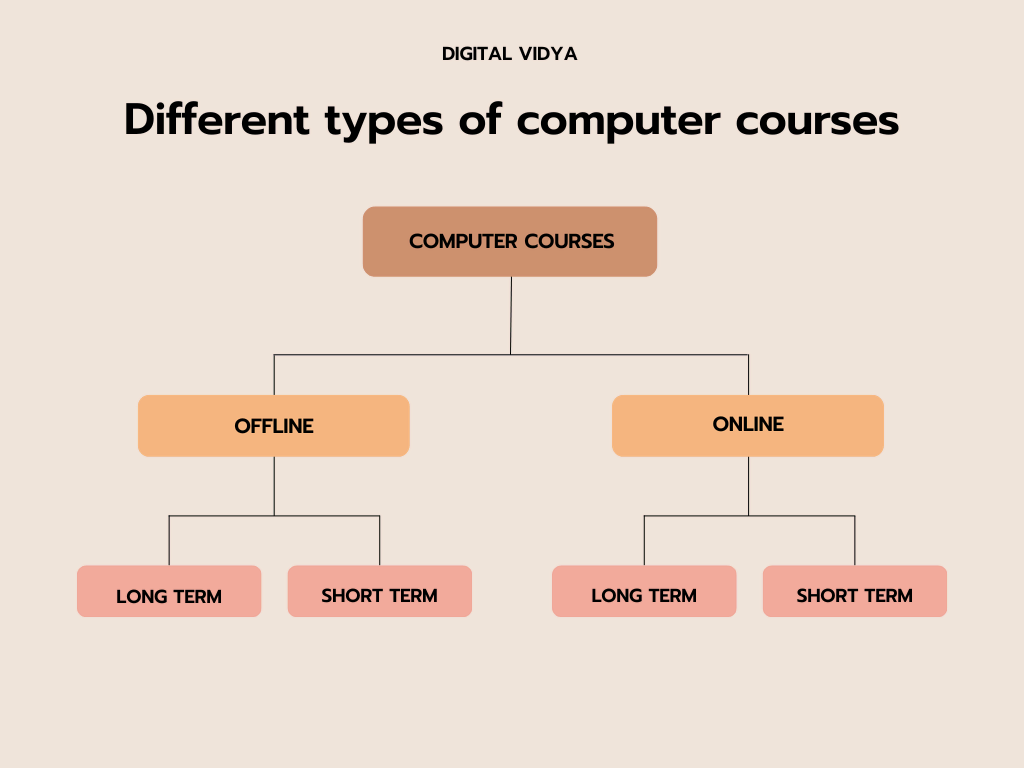
The traditional form of education has seen a remarkable transformation. Instead of long offline courses, students prefer short-term online courses, which keep them at ease as they don’t have to travel and are free to study anytime.
There are four types of courses.
1. Long-Term Offline Courses
These will include full-time or part-time four years of engineering in computer science, BCA, or any other course. This is a long course and requires some eligibility criteria.
2. Long-Term Online Courses
Many online courses are also available for mastering computers and becoming professionals. These are long-term, i.e., a year or more. These courses cover everything extensively.
The course material and tests are provided to you in videos, pdf, or both. Various tests are conducted based on the syllabus taught, and based on that, certification is given to candidates.
3. Short Term Offline Courses
Various coaching institutes also have computer courses in their curriculum. These courses are for a shorter duration, maybe 2-3 months. Physical computer classes are available for these courses.
The computer classes are held weekly or on weekends at a particular time specified by the institute. The exam is also conducted, and based on that, and certification is provided.
4. Short-Term Courses
Taking a short-term online course. These courses are available online in the form of videos, pdf, or both.
There is no set time or duration for which you must sit for the course. One can complete the course at his/her convenience. However, some courses have a duration after which the course is no longer available to you.
Now that you have understood why one should opt for computer courses and the types of computer courses, the next thing in line is the Computer courses list.
Popular Computer Courses List
Various computer courses are available, but one must choose wisely, taking into consideration which one will yield maximum interest and they will enjoy.
| COMPUTER COURSE | SKILL SET | JOB OPPORTUNITIES |
|---|---|---|
| Digital Marketing Course | SEO, SEM, Branding, Content Marketing, Marketing Analytics, Social Media Marketing | Digital Marketing, SEM, SEO, Social Media, and Content Manager. |
| Data Analytics Course | Statistics, Predictive Analytics using Python, Machine Learning, Data Visualization, Big Data Analytics, etc. | Business Analyst, Product Analyst, Machine Learning Engineer, Data Scientist |
| Data Science Course | Statistical analysis and computing, Machine Learning, Deep Learning, Processing large data sets, Data Visualization, Data Wrangling, Mathematics, Programming, and Statistics. Big Data, etc. | Data Scientist, Data Analyst, Data Engineer, Data Mining Engineer, Data Architect, Data Statistician, and Project Manager. |
| Artificial Intelligence Course | NLP, Deep Learning, Reinforcement Learning, and Graphical Models, along with a solid foundation in Predictive Analytics and Statistics | Machine Learning Engineer, Robotic Scientist, Data Scientist, Research Scientist, and Business Intelligence Developer. |
| Machine Learning Course | Statistics, Probability, Data Modeling, Programming Skills, Programming Fundamentals, and CS, Applying ML Libraries & Algorithms, Software Design, and ML Programming Languages. | Machine Learning Researchers, AI Engineer, Data Mining and Analysis, Machine Learning Engineers, Data Scientists, Business Intelligence (BI) Developer. |
| Cyber Security Course | Statistics, Probability, Data Modeling, Programming Skills, Programming Fundamentals, and CS, Applying ML Libraries & Algorithms, Software Design, and ML Programming Languages. | Network Security Engineer, Cyber Security Analyst, Security Architect, Cyber Security Manager, Chief Information Security Officer (CISO), Information Security Manager, and Cybersecurity Engineer. |
| Ethical Hacking Course | Statistics, Probability, Data Modeling, Programming Skills, Programming Fundamentals, and CS, Applying ML Libraries & Algorithms, Software Design, and ML Programming Languages. | Network Security Engineer, Cyber Security Analyst, Security Architect, Cyber Security Manager, Chief Information Security Officer (CISO), Information Security Manager, and Cybersecurity Engineer. |
| SEO Course | Analysis, Research, Coding basics, Keyword research skills, Intent Analysis, Understanding Server Management | Digital Marketing Manager, SEO Analyst, SEO Manager, Social Media, and Content Manager. |
| Tableau Course | Literacy in data analytics, Query data with ANSI SQL, Tableau Desktop, And data visualization. | Tableau Consultant, Data Analyst, Business Analyst, and Business Intelligence Analyst. |
| Full Stack Developer Course | Front-end Languages and Frameworks, Backend Technologies and Frameworks, Database Management Systems, Version Control, and Web Hosting Platforms | Full Stack Engineer, Software Engineer, Backend Developer. |
| Web Development Course | HTML/CSS skills, Analytical skills, Responsive design skills, JavaScript skills, Testing and debugging skills, Back-end basics, and Search engine optimization. | Web designer, front-end designer, and UX designer |
| Blockchain | C, JavaScript, Python, Ruby, Golang, C#, and Java | Blockchain developer, Blockchain Solution Architect, Blockchain project manager, Blockchain UX designer |
| Linux | User account management, Structured Query Language (SQL), Network traffic packet capture | DevOps Engineer, Java Developer, Software Engineer, Systems Administrator, and Systems Engineer. |
| Agile | Scrum, Kanban, and test-first, Risk Management. | Software Development Engineer, Application Development Manager, Project Manager |
| Scala | Proficiency in Scala, Knowledge of Python and Java, Strong technical skills, and experience building software solutions. | Big Data Developer, Scala manager, scala developer, Data Engineer |
| Coding | Data structures and algorithms, Database and SQL, Object-oriented programming (OOP) languages, Integrated development environments (IDEs), Cloud computing, and Web development. | Computer and Information Systems Manager, Software Engineer, Data Scientist, Full Stack Developer, Network and Computer Systems Administrator, Computer Systems Analyst |
| Spring Boo | Java code, Knowledge of OOP and design patterns, Servlets and Servlet Containers, JSP, JSTL, etc. | Spring Core Development, Spring MVC Development, Spring Security, Spring Web Service Development. |
| PHP | PHP, Ajax, jQuery, MySQL, APIs, Unix/Linux, and MVC Framework Architecture. | PHP developers, full-stack engineers, back-end programmers |
| Node.js | Node.js, Web application frameworks, front end, Databases, Package management. | Node.js developer, Front-end developer, UX/UI developer, back-end developer |
1. Digital Marketing Course
Due to the increasing market demand and the higher pay of digital marketers in India, digital marketing has become very popular among students and professionals.
Taking a digital marketing course will help raise your value in the marketplace and prepare you for a career in digital marketing.
Digital marketing businesses prefer marketing professionals with genuine knowledge, skills, and experience verified by a certification accepted across industries.
Skill Set -SEO, SEM, Branding, Content Marketing, Marketing Analytics, Social Media Marketing
Job Opportunities – Digital Marketing Manager, SEM Manager, SEO Manager, Social Media, and Content Manager.
2. Data Analytics Course
As per a recent report, the data is expected to grow 50 times by 2020 (Aureus Analytics).
The ability to analyze this data is not increasing proportionally, leading to a talent gap in skilled candidates in this space.
Through this course, you will learn how to become a Data Analyst.
The courses are designed for technical and non-technical professionals, helping them master descriptive and inferential statistics, hypothesis
testing, regression analysis, data blending, data extracts, and forecasting.
Skill Set – Statistics, Predictive Analytics using Python, Machine Learning, Data Visualization, Big Data Analytics, etc.
Job Opportunities – Data Analyst, Data Scientist, Product Analyst, Machine Learning Engineer, Business Analyst
3. Data Science Course
With the evolution of technology, data science is more relevant than ever.
Companies rely on data scientists’ information to make informed decisions about their companies.
Therefore, taking a data science course is an excellent option for someone looking for a rewarding, high-paying job.
Data science is a popular career field where data scientists capture and work with data to make sense of unorganized and jumbled-up information.
Skill Set – Statistical analysis and computing, Machine Learning, Deep Learning, Processing large data sets, Data Visualization, Data Wrangling, Mathematics, Programming, and Statistics. Big Data, etc.
Job Opportunities – Data Scientist, Data Analyst, Data Engineer, Data Mining Engineer, Data Architect, Data Statistician, Project Manager.
4. Artificial Intelligence Course
Recent research shows that the demand for Artificial Intelligence and machine learning has seen a 60% Rise.
However, many Indian companies feel there is a shortage of skilled professionals in this field.
With so much demand and not enough professionals, a computer course in AI can be helpful for your career growth.
Skill Set – NLP, Deep Learning, Reinforcement Learning, and Graphical Models, along with a solid foundation in Predictive Analytics and Statistics
Job Opportunities – Machine Learning Engineer, Robotic Scientist, Data Scientist, Research Scientist, Business Intelligence Developer.
5. Machine Learning Course
Would you be surprised if we told you that over 50,000 job vacancies in Machine Learning in India?
Because Machine Learning is one of the popular career fields, this may seem shocking.
But this gap makes opting for a machine learning course so worthwhile.
These computer courses are for Tech Professionals Seeking to Build Expertise in AI/ML from India’s leading Machine Learning Lab.
Skill Set – Statistics, Probability, Data Modeling, Programming Skills, Programming Fundamentals, and CS, Applying ML Libraries & Algorithms, Software Design, and ML Programming Languages.
Job Opportunities – Machine Learning Researchers, AI Engineers, Data Mining and Analysis, Machine Learning Engineers, Data Scientists, Business Intelligence (BI) Developer.
6. Cyber Security Course
A Cyber Security Course will help you:
Discover security vulnerabilities across a network using network hacking techniques and vulnerability scanning.
Perform network monitoring to discover and identify potential hackers and malware using tools like Wireshark, Tcpdump, and Syslog.
Understand how to best use methods of authentication, including passwords, and multi-factor authentication, including soft tokens and hard tokens.
Skill Set – Statistics, Probability, Data Modeling, Programming Skills, Programming Fundamentals, and CS, Applying ML Libraries & Algorithms, Software Design, and ML Programming Languages.
Job Opportunities – Network Security Engineer, Cyber Security Analyst, Security Architect, Cyber Security Manager, Chief Information Security Officer (CISO), Information Security Manager, Cybersecurity Engineer.
7. Ethical Hacking Course
Ethical hackers are professional hackers who have permission to the organization’s network system and prevent them from illegal hackers by applying necessary measures.
An ethical hacking course will introduce you to different types of ethical hackers and ethical hacking tools.
This course is a great stepping stone to becoming a trusted cybersecurity professional.
Skill Set – Statistics, Probability, Data Modeling, Programming Skills, Programming Fundamentals, and CS, Applying ML Libraries & Algorithms, Software Design, and ML Programming Languages.
Job Opportunities – Network Security Engineer, Cyber Security Analyst, Security Architect, Cyber Security Manager, Chief Information Security Officer (CISO), Information Security Manager, Cybersecurity Engineer.
8. SEO Course
Search engine optimization (SEO) is improving your website to increase visibility on popular search engines such as Google and Bing.
In an SEO course, you’ll learn all things related to SEO, including website optimization, link building, keyword research, and much more
Skill Set – Analysis, Research, Coding basics, Keyword research skills, Intent Analysis, Understanding Server Management
Job Opportunities – Digital Marketing Manager, SEO Analyst, SEO Manager, Social Media, and Content Manager
9. Tableau Course
Tableau is a trusted tool for creating vibrant & interactive visualizations quickly.
The requirement of Tableau professionals is getting higher and higher with the increase in Data produced.
Tableau professionals are getting the highest salaries in the industry, and Top Companies of the world, like Facebook, KPMG, Bank of America, DELL, etc., are increasingly looking for Tableau talent.
Skill Set – Literacy in data analytics, Query data with ANSI SQL, Tableau Desktop, And data visualization.
Job Opportunities – Tableau Consultant, Data Analyst, Business Analyst, Business Intelligence Analyst.
10. Full Stack Developer Course
Full Stack Developers are developers that design complete apps and websites. They work on all facets of development, from frontend to backend, to a database, and even debugging and testing.
Some different technologies and frameworks one learns about in a Full Stack Developer Course are-
(i) Frontend – HTML, HMTL5, CSS3, Twitter Bootstrap, JavaScript, jQuery
(ii) Backend – Node.js, Meteor.js, Angular 2, PHP, Ruby on Rails
(iii) Database – MySQL, PostgreSQL, MongoDB, CouchDB, Apache Cassandra
(iv) Other Essential Technologies – Memcached, Redis, Apache Lucene, Apache Solr
(v) Debugging/Version Control – GIT, Subversion, Task Runners (Grunt, Gulp), Debuggers (Xdebug, Firebug)
Skill Set – Front-end Languages and Frameworks, Backend Technologies and Frameworks, Database Management Systems, Version Control, and Web Hosting Platforms
Job Opportunities – Full Stack Engineer, Software Engineer, Backend Developer
11. Web Development Course
The web development course is a trending one these days as it helps one learn:
(i) To build websites and web apps(ii) To Build HTML-based mobile apps
(iii) How to Bid for projects on freelance websites
(iv) How to Start their own online business
(v) How to be a comfortable front-end developer
(vi) Being proficient with databases and server-side languages
Skill Set – HTML/CSS skills, Analytical skills, Responsive design skills, JavaScript skills, Testing and debugging skills, Back-end basics, Search engine optimization.
Job Opportunities – web designer, front-end designer, and UX designer
12. Blockchain:
This course is for you if you want to get started in the blockchain world.
This course will give you the foundation to begin working with this exciting new technology, covering everything from the basics of distributed ledger technology to how to build applications on top of a blockchain.
Skill Set – C, JavaScript, Python, Ruby, Golang, C#, and Java
Job Opportunities – Blockchain developer, Blockchain Solution Architect, Blockchain project manager, Blockchain UX designer
13. Linux:
Linux is a versatile operating system that can be used for anything from web servers to embedded systems.
In this course, you’ll learn
the basics of working with Linux, including installing and configuring the operating system, working with the command line, and managing files and directories.
Skill Set – User account management, Structured Query Language (SQL), Network traffic packet capture
Job Opportunities – DevOps Engineer, Java Developer, Software Engineer, Systems Administrator, Systems Engineer.
14. Agile:
Agile is a popular project management methodology that emphasizes flexibility and collaboration.
In this course, you’ll learn the basics of agile methodology and how to apply it to your projects.
You’ll also learn about some of the most popular agile tools and techniques, such as scrum and Kanban.
Skill Set – Scrum, Kanban, and test-first, Risk Management
Job Opportunities – Software Development Engineer, Application Development Manager, Project Manager
15. Scala:
Scala is a powerful programming language that combines the best features of both object-oriented and functional programming.
In this course, you’ll learn the basics of Scala, including how to write and run Scala code, how to work with the Scala REPL, and how to use the SBT build tool.
Skill Set – Proficiency in Scala, Knowledge of Python and Java, Strong technical skills, experience in building software solutions
Job Opportunities – Big Data Developer, Scala manager, scala developer, Data Engineer
16. Coding:
Coding is a fundamental skill for all developers, regardless of their programming language.
In this course, you’ll learn the basics of coding, including how to write and run code, debug code, and use standard coding conventions.
Skill Set – Data structures and algorithms, Database and SQL, Object-oriented programming (OOP) languages, Integrated development environments (IDEs), Cloud computing, and Web development.
Job Opportunities – Computer and Information Systems Manager, Software Engineer, Data Scientist, Full Stack Developer, Network and Computer Systems Administrator, Computer Systems Analyst
17. Spring Boot:
Spring Boot is a popular framework for building web applications in Java.
In this course, you’ll learn about some of the features that make Spring Boot so helpful, such as automatic configuration and dependency management.
You’ll also learn how to create and run a Spring Boot application.
Skill Set – Java code, Knowledge of OOP and design patterns, Servlets and Servlet Containers, JSP, JSTL, etc.
Job Opportunities – Spring Core Development, Spring MVC Development, Spring Security, Spring Web Service Development.
18. PHP:
PHP is a popular server-side scripting language that is used for web development.
In this course, you’ll learn the basics of PHP, including how to write and run PHP code, how to work with the PHP interpreter, and how to use shared PHP libraries.
Skill Set – PHP, Ajax, jQuery, MySQL, APIs, Unix/Linux, and MVC Framework Architecture.
Job Opportunities – PHP developers, full-stack engineers, back-end programmers
19. Node.js:
Node.js is a popular platform for building server-side applications in JavaScript.
In this course, you’ll learn about some of the features that make Node.js so helpful, such as its event-driven architecture and non-blocking I/O support.
You’ll also learn how to create and run a Node.js application.
Skill Set – Node.js, Web application frameworks, front end, Databases, Package management.
Job Opportunities – Node.js developer, Front-end developer, UX/UI developer, back-end developer
Computer Courses List After 12th
1- Associate Degree Courses:
It is a two-year degree course that can be done after the 12th in any stream. It covers all the topics related to computer hardware and software. Mainly it covers computer programming, calculus, circuits, and data structure. Fees will be around INR 7,00,000 – 9,00,000.
2 – 6-Month Undergraduate Courses:
These are short-term courses that can be done after the 12th. They focus more on computer applications and programming. The fee is INR 5,000 – 1,50,000. Some of the standard 6-month courses are-
Some of the common undergraduate computer courses after 12th are-
| COMPUTER COURSE | DURATION | AVERAGE FEES |
|---|---|---|
| Hardware and Networking Course | 6 months | INR 10,000 |
| Data-Entry-Operator Course | 6 months | INR 3,000 |
| Computer Hardware Maintenance | 6 months | INR 2,000 |
| Web Designing | 18 months | INR 12,000 |
| VFX and Animation | 8 months | INR 30,000 |
| Software and Programming Language Courses | 12 months – 15 months | INR 2,000 – INR 10,000 |
| Tally | 3 months | INR 3,000 – INR 6,000 |
| Cyber Security Courses | 3 months – 2 years | INR 15,000 – INR 20,000 |
| Microsoft Office and Typing Courses | 150 hours | INR 7,500 – INR 10,000 |
| Diploma in Computer Science | 12 months | INR 35,000 |
3 – Diploma in Computer Courses:
Many diploma courses can be done after the 12th. The course covers topics like computer hardware, networking, and software. It also includes subjects like mathematics and physics. These are also known as the best computer courses after 12th-
Some of such courses and their avg. fees are-
| COMPUTER COURSE | AVERAGE FEES |
|---|---|
| Diploma in Computer Science & Engineering (DCSE) | INR 10,000 – INR 5,00,000 |
| Diploma in Computer Applications (DCA) | INR 2,00,000 – 5,00,000 |
| Diploma in Computer Programming (DCP) | INR 2,00,000 – 5,00,000 |
| Diploma in Computer Science | INR 15,000 – 50,000 |
| Diploma in Computer Engineering | INR 1,00,000 – 5,00,000 |
4 – Bachelors (BTech, BCA, BSc, BCA Honors)
A Bachelor’s degree in Computer Course is a 3-4 year course that can be done after the 12th. The course covers topics like computer hardware, networking, and software.
It also includes subjects like mathematics and physics. Some of such computer courses after 12th and their avg. fees are-
| COMPUTER COURSE | AVERAGE FEES |
|---|---|
| Bachelor of Computer Applications (BCA) | INR 30,000 – 10,00,000 |
| BSc in Computer Technology | INR 1,00,000 – 10,00,000 |
| BE Computer Engineering | INR 20,000 – 2,00,000 |
| BCA Honors | INR 1,00,000- 10,00,000 |
| Diploma in Computer Engineering | INR 10,000- 2,00,000 |
You can gain admission to the B Tech course by high scores in entrance examinations such as JEE Main, JEE Advanced, TANCET, etc. The entrance examination also determines whether you are eligible for a BSc in computer technology or a BCA. However, BCA, BSc, etc., admissions are merit-based.
Post Graduate Computer Courses
Some of the most famous PG courses in computers are-
| COMPUTER COURSE | AVERAGE FEES | AVERAGE SALARY |
|---|---|---|
| MTech in Computer Science | NR 1,50,000 – 2,00,000 | INR 6,00,000 – 10,00 000 |
| MCA Masters in Computer Applications | INR 40,000 – 1,50,000 | INR 2,00,000 – 6,00,000 |
| MSc in Computer Science | INR 40,000 – 3,00,000 | INR 5,00,000 – 12,00,000 |
a. MTech in Computer Science:
It is a 2-year course that can be done after BTech Computer Science. The course covers computer networks, database management, and software engineering. M.Tech in Computer Science Admissions are done through taking and passing Entrance Examinations, such as GATE, PGCET, UPSEE, or TANCET.
The fees for this course are INR 1,50,000 – 2,00,000
On average, after completing this course, students receive a salary between INR 6,00,000 – 10,00 000.
b. MCA Masters in Computer Applications:
It is a 2-year course that can be done after BCA or BSc in Computer Science. Admissions to MCA courses are contingent on entrance examinations such as MAH MCA, CET, NIMSAT, etc.
The fees for this course are INR 40,000 – 1,50,000.
The average salary for graduates of this course is INR 2,00,000 – 6,00,000 per annum. However, some people earn as much as 13,00,000 per annum.
c. MSc in Computer Science:
It is a 2-year course that can be done after BSc in Computer Science.
The entrance exams decide who may attend the MSc in Computer Science program. A Bachelor’s degree with 50 percent or more aggregate grades in Computer Science, Mathematics, and other related fields is required.
M.Sc in Computer Science courses typically cost anywhere from INR 40,000 – 3,00,000 on average.
Once you complete the program and enter the workforce full-time, you can expect to earn a salary of approximately INR 5,00,000 – 12 lakhs per year.
E- Certificate Courses for the job:
Various institutes offer many certification courses that one can take up to improve their skills and get a job.
| COMPUTER COURSE | TOPICS COVERED |
|---|---|
| Oracle Course | SQL, PL/SQL, Database Design, and Backup & Recovery. |
| RHCE Course | Linux Installation & Configuration, Networking Services, and Security. |
| CCNA Course | IP Addressing, Routing Protocols, and Switching Technologies. |
| MCSE Course | Windows Server Administration, Networking with Windows Server, and Active Directory. |
| CEH Course | Footprinting & Reconnaissance, Scanning Networks, and Enumeration. |
1. Oracle Certification:
It is a course that provides in-depth knowledge of relational database management systems.
The course covers SQL, PL/SQL, Database Design, and Backup & Recovery. Oracle certification courses are offered by many institutes like NIIT, Aptech, Jetking, and so on.
After completing the course, you can work as an Oracle Database Administrator, Oracle Developer, or Oracle Apps DBA.
2. RHCE Certification:
The Red Hat Certified Engineer (RHCE) course provides in-depth knowledge of Linux systems.
The course covers Linux Installation & Configuration, Networking Services, and Security. RHCE certification courses are offered by many institutes like NIIT, Aptech, Jetking, and so on.
3. CCNA Certification:
The Cisco Certified Network Associate (CCNA) course provides in-depth knowledge of networking concepts.
The course covers IP Addressing, Routing Protocols, and Switching Technologies.
Many institutes like NIIT, Aptech, Jetking, etc offer CCNA certification courses.
4. MCSE Certification:
The Microsoft Certified Solutions Expert (MCSE) course provides in-depth knowledge of Microsoft technologies.
The course covers Windows Server Administration, Networking with Windows Server, and Active Directory.
MCSE certification courses are offered by many institutes like NIIT, Aptech, Jetking, and so on.
5. CEH Certification:
The Certified Ethical Hacker (CEH) course provides in-depth knowledge of ethical-hacking concepts.
The course covers Footprinting & Reconnaissance, Scanning Networks, and Enumeration.
CEH certification courses are offered by many institutes like NIIT, Aptech, Jetking, and so on.
Computer Courses List: Doctorate
| COMPUTER COURSE | ELIGIBILITY | AVERAGE FEES | AVERAGE SALARY |
|---|---|---|---|
| Ph.D. in Computer Applications | An MS in Computer Applications from a Technological university with 50% aggregate grades. | INR 35,000 | INR 10,000,000 to 25,00,000 |
| Ph.D. in Computer Science | An MS in Computer Science from a recognized university with 50% aggregate grades. | INR 10,000 – 2,75,000. | INR 6,00,000 – 14,40,000 |
Jobs after doing Computer Courses
Some of the essential computer courses name list as well as the best computer courses list for jobs are-
Some of the jobs you can get after doing Computer Courses-
| JOB PROFILE | AVERAGE SALARY |
|---|---|
| Computer Operator | INR 1,84,729 |
| Computer Technician | INR 3,06,413 |
| Computer Programmer | INR 4,80,948 |
| Computer Analyst | INR 4,57,066 |
| Senior Computer Operator | INR 2,30,000 |
| Computer Operations Analyst | INR 3,87,972 |
| Computer Processing Scheduler | INR 4,11,000 |
| Tally Assistant | INR 7,80,000 |
| Office Coordinator | INR 2,22,924 |
| Data Entry Operator | INR 1,82,024 |
| Accountant | INR 2,49,478 |
| Graphic Designer | INR 3,05,123 |
| Cloud Architect | INR 17,88,577 |
| Computer and Information Research Scientist | INR 12,00,000 |
| Cloud Consultant | INR 11,22,001 |
| Network Engineer | INR 3,36,962 |
| IT Analyst | INR 3,04,410 |
| Computer Network Architect | INR 19,24,137 |
| Customer Support | INR 3,83,273 |
| Programmer / Coder | INR 4,80,948 |
| IT Support | INR 4,98,957 |
| Mobile App Developer | INR 4,45,344 |
Download Detailed Brochure and Get Complimentary access to Live Online Demo Class with Industry Expert.
Conclusion!
While the market is flooded with institutes providing computer courses, choosing the best one with the best course curriculum and experienced faculty is essential.
When choosing an institute, one must go through its curriculum and compare it with the other. The more you learn in the computer courses, the more likely you will find a great job and have a bright future.
So if you are looking for the best computer courses to elevate your career, you can take a Digital Marketing Course or a Data Science Certification Course. You can also find many free computer courses on YouTube to learn and master relevant computer skills.
FAQ
1. What are the best computer courses to get a job?
Some of the computer courses for jobs are-
- Web Designing Courses
- VFX Courses
- Hardware and Networking Courses
- Software and Programming Language Course
- Tally erp Courses
- Cybersecurity Course
- Mobile app development
- Computer security
- Cloud Computing
- Big Data Engineering
- Software development
- Software engineering
- Web Designing
- Graphic designing, etc
2. What are the subjects in Polytechnic Computer Science?
There are several essential topics in Polytechnic Computer Courses in College, such as-.
- Mathematics
- Design and Analysis of Algorithms
- Operating Systems
- Data Communication
- Object-Oriented Concepts, etc
3. Which computer course is in demand now?
Some of the computer courses that are in demand now are-
- Digital Marketing course
- Cyber Security course
- Artificial Intelligence course
- Data Science Course
- SEO Course
- Machine Learning Course
4. Which computer skill is best for the future?
Here are some computer skills that are best for the future-Machine Learning
- Data Analysis
- Cloud Computing
- Security
- DevOps
- Blockchain
- UX Design
5. What is the duration of Computer Courses?
The duration of the computer courses depends on
- What computer course are you pursuing?
- What level of study are you pursuing?
- Where are you taking this computer course?
Usually, a short-term computer course starts from 3 months, but a PG computer course can also last for two years.
6. What is the use of Computer courses?
Computer courses are essential to developing skills in the IT industry.
These computer classes help you understand computers work and how to use various software and applications.

![Home-Maker Becomes a Specialist Social Media Marketer [7 Tips Inside]](https://pulselink.click/wp-content/uploads/2025/11/g05691b3a7cd27dbbc4972d10e4af982332c773c646776e4f7b1165443ebeb9858e9ada53d8b14ab9ddfb28377bb96557b8323a6bfbf0d455f8784215b24d3fee_1280-768x512.jpg)
