Congratulations on completing your B.Com!
This degree has given you a fantastic foundation in the world of commerce, finance, and business.
But now, you’re standing at a critical crossroads, and the choice you make next will largely define your future career path and earning potential.
With a sea of options—from professional certifications like CA and CFA to master’s degrees like MBA, or high-demand tech courses in Data Analytics and Digital Marketing—it’s easy to feel overwhelmed.
Choosing the right post-graduation course is no longer just an option; it’s a necessity. It’s the key to:
- Specializing in a high-growth field.
- Significantly increasing your starting salary.
- Building a secure, long-term career, not just finding a job.
This guide is designed to cut through the confusion and give you a clear, comprehensive look at the best courses after B.Com, helping you make the most informed decision for your future.
Are you looking for the Best Courses after B.com with Placements?
Here in this blog, we will let you know Courses after B.Com that can enhance your career.
A graduation degree is not enough to make a secured career for you even though you would have done B.com or Commerce courses from one of the best commerce colleges.
It’s good that you have just graduated but is that enough to get you a good job?
You will have to explore more career options including diploma courses. Questions like What to do after B.Com? or What can I do after B.Com? will start occupying your mind shortly.
How to Choose the Right Course After B.Com
With so many options, making a choice can be overwhelming. Your B.Com was the “what”; this next step is the “where.” Use these four factors to find the path that’s the right fit for you.
1. Start with Your Interests
Your career will be long, so you should at least enjoy the core of what you do. Where did you find yourself paying the most attention during your B.Com?
- Love Numbers & Auditing? If you enjoyed taxation, financial accounting, and auditing, a Chartered Accountant (CA) is the gold standard.
- Fascinated by Corporate Law? If you were more interested in business law and corporate governance, the Company Secretary (CS) path is a perfect fit.
- Excited by Tech & Data? If you see the future in technology, a certification in Data Analytics, Business Analytics, or Digital Marketing will let you combine your business knowledge with in-demand tech skills.
- Drawn to the Stock Market? If investment, portfolio management, and the stock market excite you, the Chartered Financial Analyst (CFA) is your clear choice.
- Want to be a Leader? If you’re a “big picture” person who enjoys management, leadership, and strategy, an MBA (Master of Business Administration) is designed for you.
2. Define Your Career Goals
What does “success” look like to you? Be honest with yourself.
- Goal: Highest Salary Potential: CA, CFA, and an MBA from a top-tier institute are consistently the highest-paying paths in finance and management.
- Goal: Global Opportunities: If you want to work abroad, focus on globally recognized certifications. ACCA (Association of Chartered Certified Accountants), CPA (Certified Public Accountant), and CFA are respected in dozens of countries.
- Goal: Work-Life Balance: While every high-paying job has its pressures, roles in Data Analytics, Digital Marketing, or corporate finance (after a certification like CMA) often provide a more predictable and balanced schedule compared to high-stakes fields like investment banking or audit-season CA roles.
- Goal: Job Security: Professional qualifications like CA and CS offer immense job security and respect in India, as their functions are legally mandated for many companies.
3. Consider Your Time & Financial Commitment
This is the practical reality check.
- Long-Term, Low-Cost: CA and CS are very inexpensive to pursue. Their “cost” is time and effort, requiring 3-5 years of intense, dedicated study and articleship.
- Short-Term, High-Cost: An MBA is a 2-year, full-time commitment with a very high financial cost, often running into many lakhs. The ROI is only worth it if you get into a top-tier college.
- Short-Term, Low-Cost: Courses like Digital Marketing, Data Analytics, or Financial Modeling are the fastest route to a job. You can become certified and job-ready in just 3-12 months for a fraction of the cost of an MBA.
4. Professional Certification vs. Master’s Degree
What’s the difference? Think of it as a specialist vs. a generalist.
- Professional Certification (CA, CFA, ACCA, etc.)
- What it is: A deep-dive specialization. It makes you an expert in one specific domain (e.g., accounting, investment, or corporate law).
- Best for: Roles that require deep technical expertise. Your qualification is your job title (you are a “Chartered Accountant”).
- Pro: Highly respected, commands a high salary, and provides incredible domain authority.
- Con: Can be a long, difficult process with multiple exams. It’s less flexible if you decide you want to switch to a different field like marketing.
- Master’s Degree (MBA, M.Com, etc.)
- What it is: A broad, high-level education. It’s designed to make you a manager and strategic thinker.
- Best for: Leadership, management, and consulting roles across various industries (Finance, Marketing, HR, Operations).
- Pro: Highly versatile, builds a strong professional network, and is the classic path to senior management.
- Con: An MBA is extremely expensive, and its value is heavily dependent on the college’s reputation. An M.Com is more academic and may not lead to the same high-paying jobs as an MBA or CA.
Comparison Table: Top Courses After B.Com in 2025
To help you compare your primary options at a glance, here is a quick overview of the most popular and high-growth career paths for B.Com graduates.
Pay close attention to the relationship between the time commitment (Average Duration) and the potential financial return (Average Salary).
| Course | Average Duration | Average Salary (LPA) | Top Job Roles |
| MBA | 2 Years | ₹7 – 20 LPA+ | Finance Manager, Marketing Manager, Business Consultant |
| Chartered Accountancy (CA) | ~4-5 Years | ₹8 – 15 LPA | Auditor, Tax Consultant, Chief Financial Officer (CFO) |
| Digital Marketing | 3-6 Months | ₹4 – 8 LPA | SEO Manager, Social Media Head, SEM Specialist |
| Data/Business Analytics | 6-12 Months | ₹6 – 12 LPA | Business Analyst, Data Analyst, Financial Analyst |
| CFA (Chartered Financial Analyst) | ~2-3 Years | ₹9 – 18 LPA | Investment Banker, Equity Research Analyst, Portfolio Manager |
This table provides a high-level summary. Now, let’s dive deeper into each of these career paths to understand what they involve and who they are best suited for.
In-Depth Career Paths After B.Com
This is where we go beyond the list. Here’s a detailed breakdown of the top 16 career paths, grouped by their core focus, to help you understand what each course truly involves.
Management Courses
This path is for aspiring leaders and “big picture” thinkers. The goal is not just to be an expert in one function but to manage the people and processes that run the entire business.
1. Master of Business Administration (MBA)
- What it is: The most popular postgraduate degree for B.Com graduates, an MBA provides a broad understanding of business management, with specializations in Finance, Marketing, HR, Operations, or Business Analytics.
- Best for: Students aiming for corporate leadership, management consulting, or high-level strategic roles. The value of an MBA is heavily tied to the reputation of the institute.
- Average Duration: 2 Years (Full-time)
- Average Salary: ₹7 LPA to ₹20 LPA+ (Salary is highly dependent on the B-school’s tier)
- Top Job Roles: Finance Manager, Marketing Manager, Business Consultant, Investment Banker, Business Analyst.
- Top Recruiters: Amazon, Boston Consulting Group (BCG), McKinsey & Co., Goldman Sachs, Tata, HDFC Bank, and all major corporations.
Professional Accounting & Finance Courses
These are globally recognized, high-authority certifications. They make you a specialist with deep technical expertise in the rules, laws, and practices of finance and accounting.
2. Chartered Accountancy (CA)
- What it is: The most prestigious professional accounting qualification in India, regulated by the ICAI. It provides expert-level knowledge of auditing, taxation, corporate law, and financial reporting.
- Best for: Individuals who are dedicated, detail-oriented, and have a strong command of numbers and law. This is the gold standard for accounting roles in India.
- Average Duration: ~4.5 to 5 Years (including articleship)
- Average Salary: ₹8 LPA to ₹15 LPA (for fresh CAs, can rise exponentially with experience)
- Top Job Roles: Auditor, Tax Consultant, Chief Financial Officer (CFO), Financial Controller, Management Consultant.
- Top Recruiters: The “Big 4” (Deloitte, EY, PwC, KPMG), as well as the finance departments of all major corporations (e.g., Tata, Reliance, HUL).
3. Company Secretary (CS)
- What it is: A professional course regulated by the ICSI, focusing on corporate law, governance, and compliance. A CS acts as the company’s chief legal expert, ensuring it adheres to all statutory and regulatory requirements.
- Best for: Students with a strong interest in corporate law, ethics, and governance. It’s less about numbers and more about legal frameworks.
- Average Duration: ~3 Years
- Average Salary: ₹6 LPA to ₹10 LPA
- Top Job Roles: Company Secretary, Compliance Officer, Legal Advisor, Corporate Governance Consultant.
- Top Recruiters: All listed companies (as it’s a mandatory role), large corporations, law firms, and consulting firms.
4. Certified Management Accountant (CMA)
- What it is: A professional certification (both Indian and US versions exist) that focuses on corporate finance and management accounting. Unlike a CA (which is more about auditing and tax), a CMA is an internal expert who helps management make strategic business decisions based on financial data.
- Best for: B.Com graduates who want to work inside a company in a strategic finance role, focusing on budgeting, cost control, and financial planning.
- Average Duration: ~1.5 to 3 Years
- Average Salary: ₹7 LPA to ₹12 LPA
- Top Job Roles: Management Accountant, Financial Analyst, Cost Accountant, Finance Manager.
- Top Recruiters: Manufacturing companies (e.g., Tata Motors), IT companies (e.g., Accenture, Wipro), and large multinational corporations (MNCs).
5. ACCA (Association of Chartered Certified Accountants)
- What it is: A globally recognized accounting certification based in the UK. It’s similar in scope to CA but with a focus on international accounting and auditing standards (IFRS).
- Best for: Students who want a globally mobile career and aim to work in MNCs, particularly those with a presence in Europe, the Middle East, or Singapore.
- Average Duration: ~2 to 3 Years
- Average Salary: ₹6 LPA to ₹10 LPA
- Top Job Roles: Audit Manager, Financial Analyst, Management Accountant, Tax Consultant (in international firms).
- Top Recruiters: The “Big 4” (Deloitte, EY, PwC, KPMG) and global shared services centers (e.g., Accenture, Capgemini, HSBC).
6. Certified Public Accounting (CPA)
- What it is: The American equivalent of India’s CA, regulated by the AICPA. It’s the highest accounting standard in the United States and is highly respected globally.
- Best for: Students who specifically want to work in the US or with US-based MNCs. It’s ideal for roles in auditing or compliance with US GAAP standards.
- Average Duration: ~1 to 2 Years
- Average Salary: ₹8 LPA to ₹14 LPA (in India-based US firms)
- Top Job Roles: Auditor, Tax Associate, Financial Analyst, Finance Manager (in US-based MNCs).
- Top Recruiters: The “Big 4” (especially their US-facing audit and tax wings), and US-based MNCs (e.g., Amazon, Google, Oracle).
Investment & Finance Courses
This category is for those fascinated by the stock market, investments, and high-finance. These roles involve managing money, analyzing market trends, and structuring financial deals.
7. Chartered Financial Analyst (CFA)
- What it is: The global “gold standard” certification for investment management professionals. The CFA charter covers investment analysis, portfolio management, wealth management, and equity research.
- Best for: Anyone passionate about the stock market, investment, and finance. It is highly mathematical and analytical.
- Average Duration: ~2.5 to 4 Years (to clear all 3 levels)
- Average Salary: ₹9 LPA to ₹18 LPA+
- Top Job Roles: Equity Research Analyst, Portfolio Manager, Investment Banker, Financial Analyst, Risk Manager.
- Top Recruiters: Investment Banks (e.g., Goldman Sachs, JP Morgan), Asset Management Firms (e.g., HDFC AMC), and Equity Research firms (e.g., CRISIL, Morningstar).
8. Financial Risk Management (FRM)
- What it is: A globally recognized certification for risk management professionals, offered by GARP. It focuses on identifying, measuring, and managing market risk, credit risk, and operational risk.
- Best for: Students with a quantitative and analytical mindset who want to work in the risk departments of banks and financial institutions.
- Average Duration: ~1 to 2 Years (to clear both parts)
- Average Salary: ₹7 LPA to ₹14 LPA
- Top Job Roles: Risk Analyst, Credit Risk Manager, Market Risk Analyst, Regulatory Risk Specialist.
- Top Recruiters: Banks (e.g., HDFC, ICICI, RBI), “Big 4” risk advisory teams, and consulting firms.
9. Investment Banking (CIB)
Top Recruiters: Boutique Investment Banks (e.g., Avendus), and the IB arms of major banks (e.g., JP Morgan, Morgan Stanley, Axis Capital).
What it is: A Certificate in Investment Banking (CIB) is a specialized short-term course (often 6-12 months) that teaches the core skills of the job: financial modeling, valuation, and deal structuring.
Best for: Highly ambitious individuals who want to get into the high-stakes, high-reward field of investment banking, helping companies raise capital or merge.
Average Duration: 6-12 Months (for certification)
Average Salary: ₹8 LPA to ₹20 LPA+ (Salaries are high but often include significant performance bonuses)
Top Job Roles: Investment Banking Analyst, Valuation Associate, Mergers & Acquisitions (M&A) Analyst.
Tech & Data-Driven Courses
This is the fastest-growing category. These courses combine your B.Com foundation in business and statistics with modern technology skills, preparing you for the most in-demand jobs today.
10. Digital Marketing
- What it is: A certification that teaches you how to market products and services online using SEO, social media, paid ads (SEM), email, and content marketing. A B.Com graduate’s understanding of business makes them ideal for analyzing marketing ROI. Digital Marketing also provides exciting career opportunities.
- Best for: Creative and analytical individuals who enjoy a fast-paced, technology-driven environment. This is a quick route to a high-demand job.
- Average Duration: 3 to 6 Months
- Average Salary: ₹4 LPA to ₹8 LPA
- Top Job Roles: SEO Manager, Social Media Manager, SEM Specialist (PPC), Content Strategist.
- Top Recruiters: All companies, from startups to large MNCs (e.g., Amazon, Flipkart) and thousands of digital marketing agencies.
To learn more, you can explore our Certified Digital Marketing Master (CDMM) Course
11. Data Analytics / Business Analytics
- What it is: A certification that teaches you to use tools like SQL, Power BI, Tableau, and Python to analyze data and provide insights for business decisions. Your B.Com background helps you understand the “business” context behind the “data.”
- Best for: Problem-solvers who enjoyed the statistics and economics side of their B.Com and like working with large datasets.
- Average Duration: 6 to 12 Months
- Average Salary: ₹6 LPA to ₹12 LPA
- Top Job Roles: Business Analyst, Data Analyst, Financial Analyst, Marketing Analyst.
- Top Recruiters: IT Companies (e.g., TCS, Infosys, Wipro), “Big 4” (Analytics Wings), and all data-driven companies (e.g., Flipkart, Amazon).
12. Financial Modeling
- What it is: A specialized skill-based course (often part of a CIB or CFA prep) that teaches you to build complex financial models in Excel. This is used to forecast a company’s performance, value a business, or analyze a new project.
- Best for: Students aiming for core finance roles in investment banking, equity research, or corporate finance. It is a must-have practical skill.
- Average Duration: 3 to 6 Months
- Average Salary: ₹7 LPA to ₹15 LPA
- Top Job Roles: Financial Analyst, Valuation Analyst, Equity Research Associate, Corporate Finance Associate.
- Top Recruiters: Investment Banks, “Big 4” (Deal Advisory teams), KPOs (e.g., CRISIL), and corporate finance departments.
Specialized & Short-Term Courses
These are job-oriented programs designed to get you “job-ready” for a specific role in the shortest possible time.
13. Business Accounting and Taxation (BAT)
- What it is: A practical, short-term certification that bridges the gap between B.Com theory and the real-world job of an accountant. It focuses on hands-on training in Tally, GST filing, TDS, and payroll.
- Best for: Fresh B.Com graduates who need practical, job-ready skills immediately to get their first job in an accounting department.
- Average Duration: 4 to 6 Months
- Average Salary: ₹2.5 LPA to ₹6 LPA
- Top Job Roles: Accounts Executive, Tax Assistant, Payroll Executive, GST Practitioner.
- Top Recruiters: Small to Mid-sized Enterprises (SMEs), accounting firms, and the finance departments of all local businesses.
14. Post Graduate Diploma in Banking (PGDB)
- What it is: A one-year diploma (often offered directly by banks like ICICI or Axis) that trains you for roles in banking operations, sales, and customer relations.
- Best for: Graduates who have a clear goal of working in the retail banking sector. Many of these programs offer a job guarantee upon completion.
- Average Duration: 1 Year
- Average Salary: ₹3.5 LPA to ₹6 LPA (often as a fixed starting package)
- Top Job Roles: Relationship Manager, Credit Analyst, Branch Officer, Financial Advisor.
- Top Recruiters: Private sector banks (e.g., ICICI Bank, HDFC Bank, Axis Bank) that run these programs.
15. Bachelor of Education (B.Ed)
- What it is: A 2-year professional degree that is mandatory for becoming a school teacher. A B.Com graduate would pursue a B.Ed in Commerce to teach subjects like Accountancy and Business Studies.
- Best for: Individuals with a passion for teaching and a stable, respectful career path.
- Average Duration: 2 Years
- Average Salary: ₹3 LPA to ₹6 LPA
- Top Job Roles: PGT (Post Graduate Teacher) or TGT (Trained Graduate Teacher) in Commerce, Accountancy, or Business Studies.
- Top Recruiters: Private Schools (e.g., DPS) and Government Schools (after clearing TET/CTET exams).
Traditional Postgraduate Courses
This is the classic academic next step, ideal for those who want to deepen their subject knowledge or enter academia.
16. Master of Commerce (M.Com)
- What it is: A 2-year postgraduate degree that is a direct extension of your B.Com. It provides an in-depth, theoretical understanding of commerce, accounting, and finance.
- Best for: Students who want to become a subject matter expert, enter academia (as a lecturer or researcher), or pursue a Ph.D. It is also the eligibility criteria for the UGC-NET exam.
- Average Duration: 2 Years
- Average Salary: ₹4 LPA to ₹7 LPA
- Top Job Roles: Lecturer/Professor (after NET), Senior Accountant, Financial Analyst, Bank Officer.
- Top Recruiters: Colleges & Universities, Banks (PO roles), and corporate accounting departments.
How to Choose the Right Course After B.Com
With so many options, making a choice can be overwhelming. Here are four key factors to consider to find the best fit for your career:
1. Your Interests & Strengths:
Are you passionate about the stock market and investments? CFA or Investment Banking might be for you.
Do you prefer the legal and compliance side of a business? Company Secretary (CS) is a great fit.
Are you a creative person who understands data? Digital Marketing or Business Analytics could be ideal.
2. Career Goals & Salary Expectations:
Professional courses like CA and CFA often lead to some of the highest-paying jobs but require significant effort.
An MBA from a top institute provides a fast track to management roles.
Short-term courses in BAT or Tally can get you a job quickly, but the starting salary may be more modest.
3. Time Commitment:
Are you willing to study for another 3-5 years?
A CA or CS program requires that. Do you prefer a 2-year full-time program?
An M.Com or MBA is a good choice. Or would you rather get job-ready in 6-12 months?
A Digital Marketing or Data Analytics certification is the fastest path.
4. Cost vs. ROI:
Courses like an MBA or a US-based CPA certification can be expensive.
Professional courses like CA or CS have a very low financial cost but require immense time and study.
Always weigh the course fee against the average starting salary (Return on Investment) you can expect.
Emerging High-Growth Fields: Data & Tech Courses for B.Com
Your B.Com degree’s focus on statistics and economics provides a perfect foundation for today’s most in-demand tech roles.
Data or Business Analytics
Companies need professionals who can analyze data to make smart business decisions. As a B.Com graduate, you already understand the “business” side; a certification in Business Analytics teaches you the “data” side (tools like SQL, Power BI, and Python).
- Average Salary: ₹6 LPA – ₹12 LPA
- Top Roles: Business Analyst, Data Analyst, Financial Analyst.
Financial Modeling
This course teaches you to build dynamic models in Excel to forecast a company’s financial performance. It’s a critical skill for roles in investment banking, equity research, and corporate finance.
- Average Salary: ₹7 LPA – ₹15 LPA
- Top Roles: Financial Analyst, Valuation Associate, Equity Research Analyst.
Here is the infographic with details of all top courses after B.com
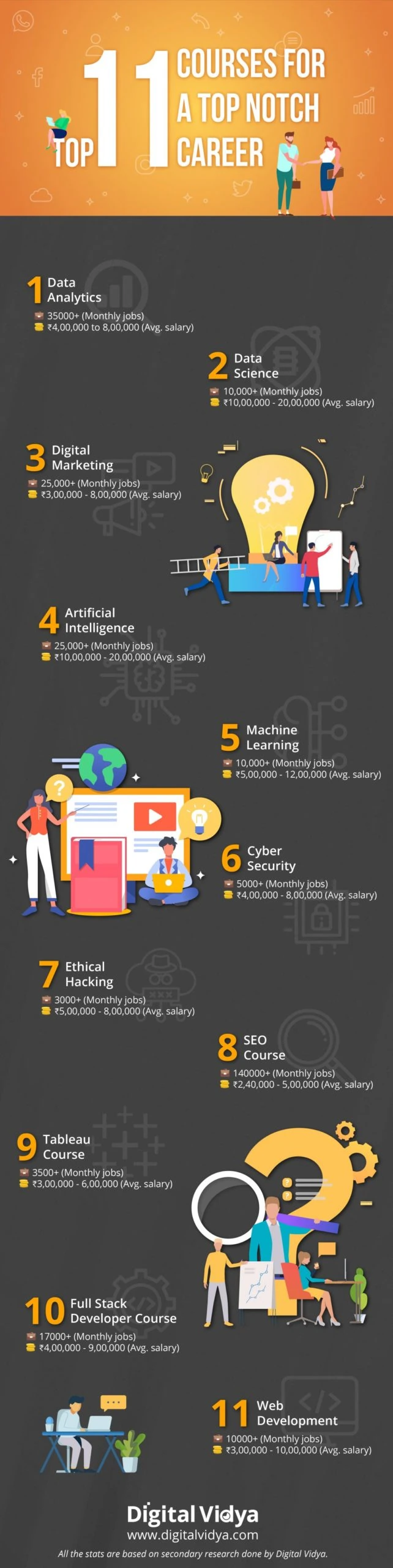
Your Future After B.Com: It’s Time to Specialize
Completing your B.Com is a significant achievement, but it’s just the first step. The real key to a high-growth career and a “handsome package” lies in what you do next: specialization.
As we’ve explored, your options are vast—from the deep financial expertise of a CA or CFA and the leadership track of an MBA, to the high-demand, tech-driven fields of Data Analytics and Digital Marketing.
While a B.Com degree alone might open the door to entry-level jobs, a professional certification or postgraduate degree is what unlocks leadership roles, higher salaries, and long-term job security.
There is no single “best” path. The right choice depends entirely on you. Are you passionate about:
- Numbers and Law? Look at CA or CS.
- Investments and the Stock Market? CFA is your target.
- Leadership and Strategy? An MBA is the classic path.
- Technology and Data? Data Analytics or Digital Marketing are future-proof choices.
This investment in your skills is what will set you apart. Your B.Com gave you the foundation; this next step will build your career.
In case you want to learn and master Digital Marketing as your preferred course after B.Com, the Digital Marketing Course would be quite useful for you.
FAQ
1. What are the job-oriented courses for commerce graduates?
A commerce graduate can take up many job-oriented courses like Digital or Online Marketing, CA, CS, CFA, CFP, MBA in Finance, Marketing, HR, and Operations, Data Science Courses, Data Analyst, and Investment Banking.
2. What will be the salary of an MBA after B.com?
The salary of an MBA after B.com will largely depend on the B-School that one has passed out from and the specialization i.e. Finance, Marketing, HR, and Operations. However, the average salary comes to 803k per annum as per Payscale.
3. What are the government jobs after B.com?
After B.com students can apply for public sector banks like State Bank of India via the IBPS PO exam. Other jobs like RBI Grade B Officer, UPSC Civil Services Exam, UPSC CDS, SSC CGL Exam, Indian Railways, and LIC AAO Exam.
4. What Courses can a B.com do other than MBA?
Digital Marketing Courses, CS, CA, BAT, Cost Accounting, CMA, CPA, PG Diploma in Banking, Business Correspondent Courses, Insurance Courses, FRP, Chartered Financial Analyst, Financial Modeling, and Master of Commerce.
5. What are the computer courses after B.com?
Courses like Graphic Designing, UI/UX Front End Developer, Search Engine Optimization, Search Engine Marketing, Digital or Online Marketing, AutoCAD, Photoshop, MS Office, MS-CIT, C++, Java, Tally, SAP, SQL, Software Test Engineering, QA Engineer, and Quality Assurance.
6. What are the courses after B.com abroad?
Master in Management, Master in Finance, Master in International Business, Master in Business Analytics, Master in Economics, Master in Marketing, and MBA are some of the courses after B.com which can be pursued abroad.